
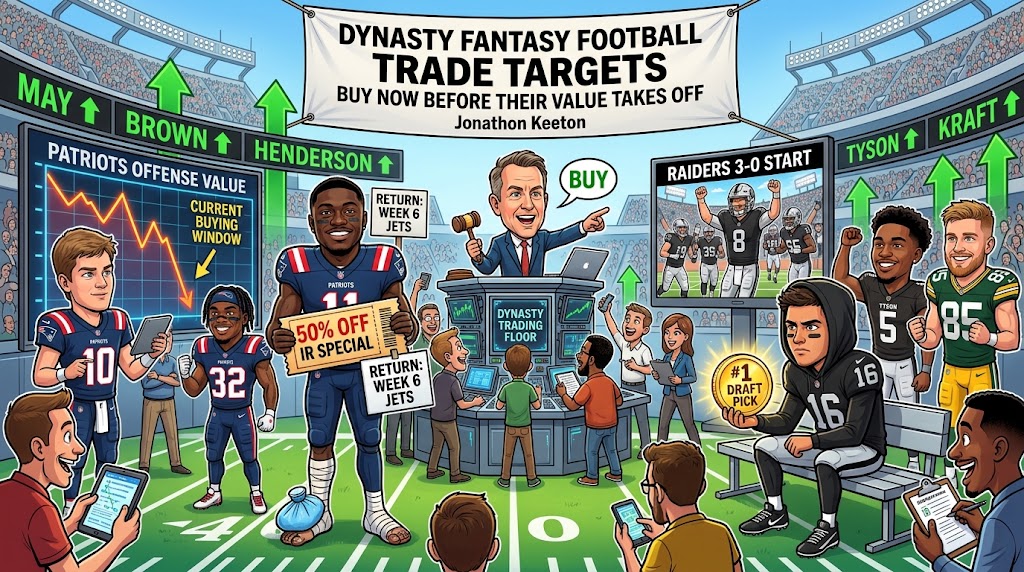
In dynasty fantasy football, timing is everything. You can identify a talented player, understand his long-term potential and still miss the opportunity if you wait too long to make the trade.
The best buying windows usually open when a player’s circumstances aren’t ideal. A quarterback hits a sophomore slump. A wide receiver lands on injured reserve. A rookie quarterback watches a veteran win games from the bench. A tight end’s production lags while his offense sorts itself out.
That’s when dynasty managers need to look past the weekly box score.
I’m Jonathon Keeton, and I’ve been a commissioner at Masters Fantasy Football Leagues for 17 years. One thing I’ve learned is that player values don’t move in a straight line. Managers get frustrated, overreact to a few weeks of production and forget what made a player valuable in the first place.
Heading into Week 4, here are six players whose situations could be creating buying opportunities:
- Drake Maye, QB, Patriots: a slump without his top receiver
- AJ Brown, WR, Patriots: a high ankle sprain and a stint on injured reserve
- TreVeyon Henderson, RB, Patriots: a role that could grow as the offense gets healthy
- Jordyn Tyson, WR: a receiver whose quarterback is starting to develop
- Tucker Kraft, TE, Packers: a tight end surrounded by breakout receivers
- Fernando Mendoza, QB, Raiders: the No. 1 overall pick stuck behind a 3-0 veteran
Some are established players dealing with temporary setbacks. Others are young talents whose future opportunities could be worth more than their current production suggests.
The goal is simple: buy the talent before the situation improves and the price goes up.
1. Drake Maye, AJ Brown and TreVeyon Henderson: Buy the New England Offense Before It Gets Healthy
One of the biggest mistakes dynasty managers make is judging an entire offense by what it looks like when its key pieces are missing.
Drake Maye broke out last season and helped lead New England to the Super Bowl. This year started rough. He threw three interceptions in the 13-10 opening loss to Seattle, and he lost his new top target in the same game.
AJ Brown, the Patriots’ big offseason trade acquisition, suffered a high ankle sprain in the third quarter of that opener. New England placed him on injured reserve, which means Week 6 against the Jets is the earliest he can return, and reports have suggested he could miss around six weeks.
Meanwhile, TreVeyon Henderson is another player whose fantasy outlook could improve once the offense gets healthier and starts operating the way it was designed to.
The temptation is to look at the early struggles and sell. My approach is different: evaluate what this offense could look like when its key players are back.
Drake Maye: Don’t Give Up on a Quarterback Who Just Broke Out
Dynasty managers have short memories.
Last season, Maye proved he could lead a team through a deep playoff run. Now, with expectations higher and the offense missing its best receiver, the conversation has shifted toward a possible slump.
That’s exactly why I’m interested in his dynasty trade value.
Young quarterbacks often go through uneven stretches as defenses get more film, opposing coordinators adjust and the player learns to handle new looks. A difficult stretch doesn’t mean the development has stopped.
Brown’s absence matters here. Losing an established, high-level receiver changes what a young quarterback has to work with. It affects spacing, third-down conversions, red-zone efficiency and the ability to make difficult throws look routine.
I’m not suggesting every problem disappears when Brown returns. Maye still has to protect the football, make good decisions and show that last season’s success can be sustained.
But if you’re evaluating Maye’s long-term dynasty value, you have to account for the circumstances around his current production.
The trade strategy: If another manager is treating Maye like a quarterback who has lost his trajectory rather than a young passer in a tough stretch, find out what it costs to acquire him. His breakout gives you a real reason to investigate, especially in Superflex leagues.
AJ Brown: An Injury Can Create a Buying Window
Brown’s high ankle sprain is a short-term obstacle with a real effect on his fantasy production this season.
For managers chasing immediate points, that absence is frustrating. For dynasty managers with enough roster depth to wait, it may create an opportunity to negotiate.
Brown has already proven he can be a difference-making fantasy receiver, with six 1,000-yard seasons on his résumé, and he’s still only 29. The question isn’t whether the injury matters. It does. The question is whether his temporary unavailability has pushed his dynasty price low enough to justify a deal.
His return could help Maye, lift the passing offense and change how defenses approach New England’s receiving group.
There are no guarantees everything clicks immediately. High ankle sprains can affect a player’s movement even after he’s back on the field, so monitor his health closely. But the injury doesn’t erase his longer-term value.
The trade strategy: Contenders should weigh the potential payoff against the cost of waiting several weeks for Brown to return. Rebuilding managers should compare any offer against the younger assets or future picks they could acquire instead.
TreVeyon Henderson: The Opportunity Could Look Different When Everyone Is Back
Henderson is the third piece of this buying opportunity.
Running backs are heavily influenced by the offense around them. When a team struggles to sustain drives, there are fewer scoring chances, less favorable game scripts and fewer opportunities for the running game to settle in.
When the offense improves, that can change.
If Maye settles down and Brown returns, defenses will have more reason to respect the passing game. That could open up space for the run game and help New England stay on the field longer.
Henderson still has to earn his workload, and Rhamondre Stevenson remains part of the backfield conversation. A healthier offense doesn’t guarantee more touches for any one running back, so evaluate his role on its own merits.
But the combination of offensive improvement and a potentially larger role makes Henderson worth discussing before his price changes.
The dynasty takeaway: These three players offer different paths to value. Maye is a bet on quarterback development, Brown is a bet on established talent returning from injury, and Henderson is a bet on opportunity improving as the offense gets healthier. You don’t need all three to hit for a carefully priced acquisition to pay off.
2. Jordyn Tyson: Buy Into the Quarterback Development Before the Receiver Breaks Out
When evaluating dynasty wide receivers, one of the biggest factors to watch is the quarterback situation.
A talented receiver still needs targets, consistent passing and chances to make plays. When a young quarterback starts showing real signs of development, it can change how managers view the entire receiving room.
That’s why Jordyn Tyson belongs on this list.
Tyler Shough has looked impressive, and his growth gives dynasty managers a reason to reassess the long-term outlook for the players around him.
Shough’s early success doesn’t guarantee a Tyson breakout. The opportunity is that the quarterback situation could be improving while Tyson’s dynasty price still reflects plenty of uncertainty.
Why Tyson Is Worth a Look
When I evaluate a young receiver, I focus on three things:
- Talent: Does the player have the ability to earn a meaningful role and produce consistently?
- Quarterback development: Is the passing situation showing signs of improvement?
- Price: Can you acquire the player before the market adjusts its expectations?
Tyson’s appeal is the possibility that his own development and his quarterback’s progress reinforce each other.
If Shough keeps playing well, the offense becomes more consistent and Tyson earns a bigger role, the market will start valuing him differently.
The risks are real. Health, target competition and actual usage all matter. A promising quarterback doesn’t turn every receiver into a fantasy starter.
Still, you don’t have to wait until the breakout is obvious to explore a trade.
My approach: Check the price now, especially if the current manager is focused on immediate production. Make a reasonable offer that accounts for the upside without paying as if the outcome is guaranteed.
3. Tucker Kraft: Christian Watson and Matthew Golden Are Giving Green Bay More Weapons
Tucker Kraft is an interesting target because his opportunity has to be evaluated in the context of what’s happening around him.
The Packers have two receivers worth watching closely: Christian Watson and Matthew Golden. Both have looked impressive, and in Masters fantasy scoring, Watson is currently the WR5 while Golden sits at WR13.
Those rankings matter because they show Green Bay’s passing game can support multiple productive options. For Kraft, that creates an intriguing setup.
Why the Receiving Breakouts Could Help Kraft
When an offense has multiple credible receiving threats, defenses have to decide where to commit their coverage.
If Watson keeps producing explosive plays and Golden keeps establishing himself, defenses have less freedom to focus on Kraft. That could open opportunities for the tight end over the middle, underneath and around the red zone.
There’s another side to the argument. More productive receivers also means more competition for targets. Watson and Golden succeeding doesn’t guarantee Kraft’s target share goes up.
That’s why the next step is monitoring his actual usage:
- Are his routes consistent week to week?
- Is he getting targets in scoring areas?
- Is he involved on third downs and other key situations?
- Is he converting those opportunities into production?
Those details will tell us whether the success around him is turning into real opportunity.
The Dynasty Buying Window
The reason to target Kraft now is that consistent tight end production is hard to find. If you can acquire a tight end with a proven ability to produce without paying an elite tight end price, the risk-reward becomes interesting.
If Green Bay keeps producing through the air, there’s a reasonable path for Kraft to benefit from the attention Watson and Golden draw.
But I wouldn’t pay for a breakout before it happens.
My dynasty takeaway: Watson at WR5 and Golden at WR13 in Masters scoring are reasons to pay attention to Green Bay’s passing offense. If Kraft’s trade price doesn’t reflect his potential role in that offense, now may be the time to make an offer.
4. Fernando Mendoza: The No. 1 Overall Pick Is Losing Value on the Bench
This might be the most interesting buy-low situation on the list.
Fernando Mendoza was selected first overall in the 2026 NFL Draft, making him a major long-term investment for the Raiders. But he isn’t starting. He’s watching Kirk Cousins run the offense.
Las Vegas opened the season with Cousins as its starter, with the coaching staff citing his offseason and training camp performance. That decision broke a streak of six straight No. 1 overall picks who started on opening day.
And now Cousins has unexpectedly started 3-0.
That’s a good problem for the Raiders. It’s a frustrating one for dynasty managers who drafted Mendoza expecting an immediate path to the starting job.
This is where dynasty managers need to look beyond the present.
Why the Market Gets Impatient With Rookie Quarterbacks
When a quarterback goes first overall, expectations are enormous. Managers expect him to start quickly, develop through the season and establish himself as a long-term fantasy asset.
When that doesn’t happen, the market gets impatient.
Mendoza isn’t piling up NFL production while he sits. Managers who expected an immediate starter may start questioning their investment, and his dynasty trade value can slide as a result.
But the absence of playing time isn’t the same as the absence of long-term potential.
The Raiders took Mendoza first overall for a reason. Draft position alone doesn’t guarantee success, but that investment is a big part of the long-term picture.
Kirk Cousins Is Playing Well. That Doesn’t End the Mendoza Conversation.
Cousins deserves credit for winning games and giving the Raiders a reason to keep him on the field.
At the same time, he’s 38 years old, and his strong start doesn’t settle the franchise’s long-term quarterback question. The Raiders can win now while continuing to develop the quarterback they drafted first overall.
That makes it hard to pin down when Mendoza gets his chance. There’s no guaranteed date, and Cousins’ continued success could extend the wait.
That uncertainty is also what creates the buying opportunity. If Mendoza’s price falls because managers are frustrated with his lack of playing time, you may be buying a highly drafted quarterback at a discount before he ever gets the chance to establish himself.
Why I’m Buying Mendoza Now
I’m not buying Mendoza because I know when he’ll start. Nobody can promise that.
I’m buying the possibility that the market is overreacting to a short-term depth chart situation.
Cousins’ success gives the team a reason to be patient, but it doesn’t erase the organization’s investment in its young quarterback. For dynasty managers, that creates a choice: pay the higher price if and when Mendoza becomes the starter, or check his value now while the uncertainty remains.
The risk is that Cousins keeps winning longer than expected and delays Mendoza’s opportunity. There’s also no guarantee Mendoza turns his draft status into long-term NFL success. Both risks should be built into the price you pay.
My dynasty takeaway: Fernando Mendoza is a buy-now target for managers who can afford to be patient. Cousins’ 3-0 start is creating short-term uncertainty, and that uncertainty may let you acquire the No. 1 overall pick before his path to playing time becomes clear.
Final Thoughts: Buy Before the Opportunity Becomes Obvious
The dynasty trade market is always moving. Injuries create buying windows, young quarterbacks hit developmental bumps, and surprising veterans can temporarily block highly drafted rookies.
The trick is separating temporary circumstances from long-term value.
Maye could benefit from getting his top receiver back. Brown’s injury may reward patient managers. Henderson could benefit from an improving offense. Tyson has a quarterback situation worth watching. Kraft could find room to work as Green Bay’s receivers keep producing. And Mendoza could become far more valuable once his path to playing time comes into focus.
None of these outcomes is guaranteed, and the price you pay matters just as much as the player you acquire.
In dynasty fantasy football, you don’t have to wait for a breakout to make your move. Recognize the opportunity, understand the risk and buy at a price that gives your roster room to grow.
Build Your Dynasty at Masters Fantasy Football Leagues
At Masters Fantasy Football Leagues, dynasty football is about more than this weekend’s lineup. It’s about managing assets, trading future picks, developing young talent and building a roster that can compete for years.
Masters has been serving fantasy football players since 2008, with more than 20,400 leagues filled and more than $34 million paid out. We run roughly 800 dynasty leagues and have never folded one. Every league includes live commissioner support and all-in pricing with no hidden commissioner, platform, transaction or draft fees.
Whether you’re an experienced dynasty manager chasing your next title or you’re new to the long-term strategy of dynasty football, Masters offers leagues built around the complete general manager experience:
- Dynasty leagues: Build for today while accumulating future value.
- Rookie drafts: Put your scouting and draft-pick strategy to work.
- Trades and roster management: Make moves with a long-term plan.
- Live commissioner support: Get help with league rules and managing your team.
Ready to start building your dynasty? Visit Masters Fantasy Football Leagues to explore available leagues.
Dynasty Trade Targets: Frequently Asked Questions
Who are the top dynasty buy-low trade targets right now?
Drake Maye, AJ Brown, TreVeyon Henderson, Jordyn Tyson, Tucker Kraft and Fernando Mendoza. Each offers a different buying window, from injury-related uncertainty and a sophomore slump to a rookie quarterback waiting behind a veteran starter.
Should I buy Drake Maye after a slow start?
If you believe in his long-term development and can acquire him at a price that reflects the current concerns, yes. Losing AJ Brown to injury has made his job harder, but Maye still needs to show consistent decision-making once his top receiver returns.
Is AJ Brown worth buying while he’s on injured reserve?
For managers who can absorb his absence, he can be. Brown’s high ankle sprain landed him on injured reserve with Week 6 as his earliest possible return, so weigh the recovery timeline, the chance of lingering effects and your roster’s immediate needs before making an offer.
Why is TreVeyon Henderson a dynasty trade target?
Henderson could benefit as New England’s offense gets healthier and more productive. Backfield competition still matters, so evaluate his actual role rather than assuming a better offense automatically means more touches.
Can Tucker Kraft benefit from Christian Watson and Matthew Golden?
Potentially. Productive receivers draw defensive attention, which can open up the middle of the field. Kraft’s routes, target share and red-zone usage will show whether that translates into fantasy production.
Why buy Fernando Mendoza if he isn’t starting?
Mendoza was the first overall pick in the 2026 NFL Draft, but Kirk Cousins’ 3-0 start has kept him on the bench. If frustrated managers have lowered his price, patient buyers may be able to acquire him before his path to playing time becomes clear. His starting timeline remains uncertain.
Should I trade future rookie picks for these players?
It depends on your roster, league format and the asking price. Future picks can land you young talent or established production, but don’t give up premium selections unless the return fits your long-term plan.