
Expect the Unexpected: Why Long-Term Dynasty Rankings can Miss the Mark
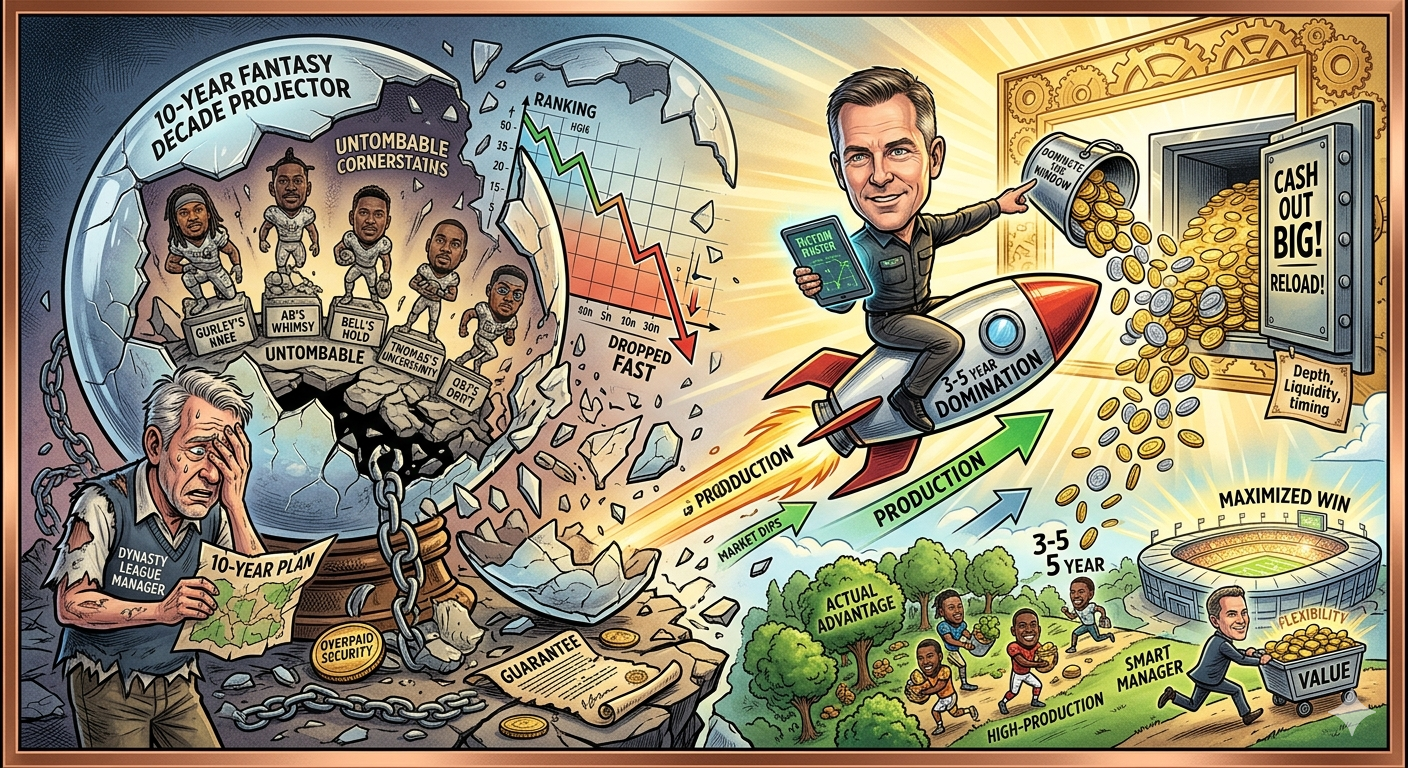
Don’t chase a decade—build to dominate a 3–5 year window and cash out big.
There’s no denying it—ranking sites are fun. Addictive, even. You can plug in trades, stack your roster, and feel like you’re building a dynasty powerhouse set up for the next decade.
But here’s the reality:
They’re built on assumptions that don’t always hold up.
Most ranking systems quietly bake in projections that can stretch 10 years into the future. That’s part of what makes them exciting—but it’s also where they can lead you astray.
Because the NFL doesn’t operate on 10-year guarantees. It operates on short, volatile windows.
The Fall of “Untouchable” Assets
We’ve all seen players labeled as “can’t miss” dynasty cornerstones—guys you were supposed to build around forever. And yet, things change fast.
- Antonio Brown — elite production that disappeared almost overnight
- Todd Gurley — dominant stretch cut short by injuries
- Odell Beckham Jr. — massive early value that never fully stabilized
- Le’Veon Bell — peak performance disrupted by contract and situation shifts
- Michael Thomas — record-setting highs followed by prolonged uncertainty
These weren’t fringe assets. These were top-tier dynasty pieces.
And within a season or two of reaching their peak, their value didn’t gradually decline—it dropped fast.
The Problem with Long-Term Projections
Ranking sites tend to reward longevity as if it’s predictable:
- Stable production curves
- Consistent team situations
- Smooth career arcs
But in reality:
- Injuries happen without warning
- Roles and teams change quickly
- Coaching and scheme shifts impact usage
- Off-field factors can alter everything
Projecting a decade ahead sounds strategic—but in many cases, it’s unrealistic. It also creates false security, where managers overpay for perceived safety instead of actual advantage.
Adjusting Your Approach: Think 3–5 Years Max
This doesn’t mean you ignore elite players or long-term upside.
It means tightening your focus.
Instead of valuing players as 10-year assets, consider:
- What can this player realistically give you over the next 3–5 years?
- How quickly could their value drop if something changes?
- Are you paying for peak hype or actual production windows?
A shorter evaluation window sharpens decision-making and keeps you flexible when the market shifts.
Finding Value in the Market
One of the most effective strategies in dynasty is buying within similar production windows at a discount.
Instead of paying a premium for a perceived long-term cornerstone, you can:
- Target players with comparable short-to-mid-term upside
- Take advantage of market dips and uncertainty
- Avoid overcommitting to inflated future projections
In many cases, a 3–5 year asset at the right price can outperform a “10-year” player whose value never holds. Depth, liquidity, and timing often beat long-term “certainty.”
Final Thought
Stop trying to build a roster that lasts forever.
That’s not how dynasty leagues are won.
Instead, build to dominate a window—attack a 3–5 year stretch with intention, stack production, and when you hit that peak… don’t be afraid to cash out, reload, and do it again.
Because the real edge isn’t having the best team “long-term.”