
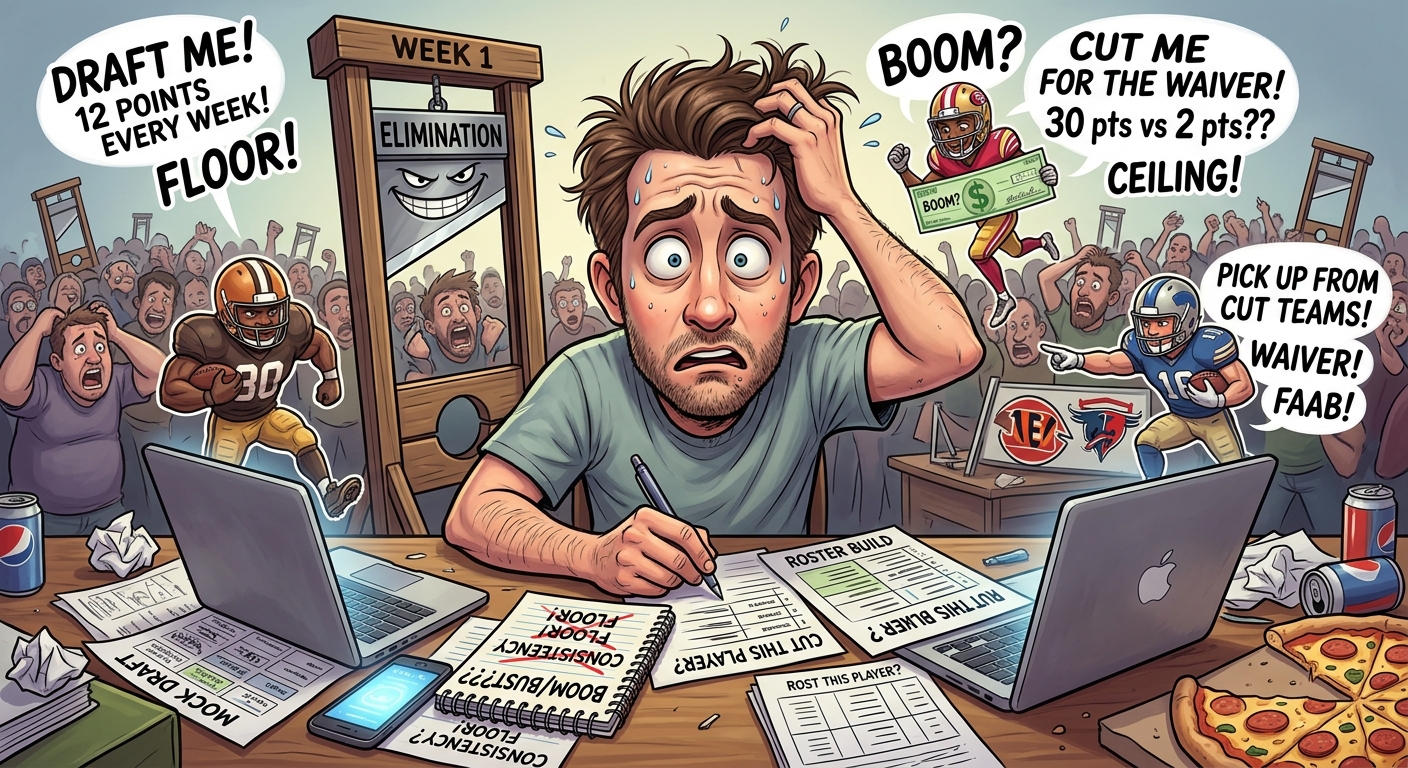
If you’ve been playing standard season-long redraft leagues for years, you probably think you know how to build a fantasy football roster. Draft the best player available, stash some upside on your bench, ride out a bad week or two, and make your move in the fantasy playoffs. That approach has worked for you in redraft. It will get you eliminated in a Guillotine league by Week 4.
Guillotine leagues are one of the fastest-growing formats in paid fantasy football, and for good reason — they’re brutal, they’re fun, and they reward a completely different skill set than the redraft leagues most of us grew up playing. But that’s exactly why so many good redraft players show up to their first Guillotine draft, apply their normal instincts, and get cut from the league before Halloween.
This is your primer. New to Guillotine? Here’s everything you need to unlearn from redraft — and exactly what to do instead — if you’ve never played before, or you tried it once and got run over.
What Is a Guillotine Fantasy Football League, Exactly?
Before we get into strategy, a quick refresher on the format itself. In a Guillotine league, every team in the league is grouped together and every player on every roster is treated as one giant scoring pool. Each week, the league tallies up total points scored across all rosters. Whichever team scored the fewest points that week is eliminated — cut entirely, guillotined, done. This repeats week after week until only one team is left standing.
There are no head-to-head matchups. There are no playoffs to sneak into with a weak team and a hot streak. There’s no comeback season where you finish 6-8 but still make a run. Every single week is do-or-die, and every single week you’re not just competing against one opponent — you’re competing against the entire league’s floor.
That structural difference is the root of everything else that changes about strategy.
Redraft Rule #1: “Draft the Best Player Available” — Bad Advice for Guillotine
In redraft, “best player available” is a perfectly reasonable draft philosophy. You’re building a roster for a 14-17 week marathon, and talent differentials tend to show up over a full season. A boom-or-bust rookie or an injury-prone stud with league-winning upside is a totally rational bench stash — you have all season to let that pick pay off, and you can plan your lineup around a bye week or a slow start.
In Guillotine, that same pick can get you eliminated in Week 1.
Guillotine drafting isn’t about assembling the most talented 15-man roster in the league. It’s about assembling the roster that is least likely to have its worst week at the wrong time. Weekly floor matters more than season-long ceiling, especially in the first month, because you don’t get 17 weeks to let your studs heat up — you might get three. A running back who’s a lock for 12-15 points every single week is more valuable early in a Guillotine draft than a boom-or-bust receiver who might drop 30 one week and 2 the next. The bust weeks are the ones that get you cut.
This doesn’t mean upside is worthless in Guillotine — it matters a lot later in the season, when the field has thinned out and everyone left is already floor-conscious. But on Draft Day, prioritize weekly-startable consistency at every position before you start chasing ceiling.
Redraft Rule #2: “Handcuffs and Bench Stashes Are Smart Roster Building” — Bad Advice for Guillotine
In a redraft league, stashing a handcuff running back or a rookie who might break out in Week 10 is textbook roster management. Worst case, that player never contributes and you cut him in November with no real cost. Best case, he wins you a league.
In Guillotine, every roster spot you spend on a “just in case” player is a roster spot not spent on a player who can help you survive this week. Since the whole league’s score is pooled and your team is judged purely on this week’s output, a bench player who contributes nothing to your lineup is functionally a zero — and zeros are how teams get eliminated. There’s no long season to justify the opportunity cost of patience.
The Guillotine mentality, as we’ve written about before, comes down to controlled aggression: build a roster of players who can plausibly start for you this week, and stay ruthless about swapping out anyone who can’t.
Redraft Rule #3: “Ride Out Slow Starts” — Bad Advice for Guillotine
Every redraft player has been here — your first-round pick starts slow, but you know the talent is there, so you hold. By Week 8 he’s the best player in your league. That patience is often rewarded in a 17-week format.
In Guillotine, patience with an underperforming asset isn’t a virtue — it’s a liability that compounds weekly. Because you’re eliminated the moment your total falls to the bottom of the league in any single week, “he’ll turn it around eventually” isn’t good enough. He needs to turn it around by Sunday, or he needs to be off your active roster. This is why we’ve argued you should drop good players without hesitation in this format — the players themselves aren’t bad, they’re just not helping you survive right now, and right now is the only timeframe that exists in this format.
Redraft Rule #4: “The Waiver Wire Is a Slow Burn” — Bad Advice for Guillotine
In redraft, the waiver wire is often a season-long chess match — you stash a handcuff in case of injury, you speculate on a change in offensive role, you wait to see how a committee shakes out before committing FAAB dollars.
In Guillotine, the waiver wire moves at a completely different speed, for a simple reason: every week, an entire team’s worth of rostered players gets dumped back into the free agent pool the moment that team is eliminated. That means the waiver wire in Guillotine isn’t just about matchup streamers and injury replacements — it’s about being ready to pounce on a wave of newly available players every single week as teams get cut. As we cover in more depth in our Guillotine FAAB strategy guide, holding your budget too conservatively for too long, hoping for a “big” player to hit the wire, often means missing the smaller, safer plays that actually keep your floor high week to week. For a full rundown of how to approach spending, surviving, and winning across the entire season, see our complete Guillotine strategy guide.
So What Should a Beginner Actually Do?
If you’re drafting your first Guillotine team, here’s the mindset shift in a single sentence: stop drafting for your best possible season, and start drafting for your worst possible week.
Practically, that means:
- Prioritize proven, weekly-consistent starters over boom-or-bust upside in the first several rounds, especially at running back and receiver.
- Avoid stacking your bench with speculative stashes who won’t help you start this week — every bench spot should have a plausible path to your active lineup soon.
- Pay close attention to early-season matchups when building your initial roster — a rough opening stretch can end your season before bye weeks even become a factor in Week 5 and beyond.
- Treat the waiver wire as an active, weekly tool rather than a season-long slow burn — stay engaged every single week, because the player pool is constantly refreshed by eliminated teams.
- Save some aggression for later. Once the field thins out, everyone remaining is already floor-focused, and that’s when calculated risks on upside plays can separate you from the pack.
Guillotine rewards a different kind of fantasy manager than redraft does — someone who thinks in terms of weekly survival instead of season-long upside, and who’s willing to make cold, unsentimental roster decisions on a Tuesday instead of waiting for a bad process to eventually produce a good result. It’s a format that punishes redraft habits fast, but for players who adapt, it’s one of the most engaging, high-stakes formats in fantasy football.
If this is your first season in the format, welcome to the chopping block. Draft smart, stay flexible, and don’t get attached to anyone.
For full format details — roster requirements, blind bidding rules, and current draft dates — check out our Guillotine League Rules and Schedule.
Frequently Asked Questions
How does elimination work in a Guillotine league? Each week, every team’s total points are compared across the entire league. Whichever team scores the fewest points that week is eliminated. This repeats every week until only one team remains. Scoring resets to zero each week, so a bad Week 1 doesn’t carry over — you just can’t afford to finish last in any single week.
What happens to the roster of an eliminated team? Every player on an eliminated team’s roster gets dropped back into the free agent pool and becomes available for blind bidding the following week. This is why the Guillotine waiver wire moves so differently than in redraft — a fresh wave of rostered players hits free agency every single week.
How much blind bidding (FAAB) budget do you get? Masters Guillotine leagues start each team with $1,000 in blind bidding dollars for the season. How you pace that budget — spending early versus saving for later waves of talent — is one of the central strategic questions in the format.
Is there trading in Guillotine leagues? No. There is no trading in Masters Guillotine leagues. The only way to improve your roster in-season is through blind bidding and first-come-first-served free agency, which is part of what makes waiver strategy so central to winning.
How big is the roster, and what’s the starting lineup? Masters Guillotine leagues use a 12-player roster with a starting lineup of 1 QB, 1 RB, 1 WR, 1 TE, 1 K, 1 DEF, and 2 flex spots (RB/WR/TE) — 8 starters total, leaving just 4 bench spots. That tight bench is intentional: it keeps quality players available on the wire every week and puts more weight on active roster management, since there’s little room to carry a speculative stash that isn’t helping your lineup right now.
What’s the format of the initial draft? Guillotine leagues run a 12-round serpentine draft, offered as both live drafts (roughly 1-2 hours, 75 seconds per pick) and email drafts (typically about a week, with an 8-hour clock that shortens over time).