
What experienced fantasy football managers are doing differently in 2026—and what you can learn before your own draft.
There is a major difference between mock drafts and real drafts. Mock drafts are filled with experimentation, auto-picks, abandoned teams, and owners willing to take chances because nothing is on the line. Our first Masters Fantasy Football Gold Division Live Draft wasn’t one of those. Every owner entered knowing they had real money invested. Every pick mattered. Every decision carried consequences. That is exactly why these results are so valuable.
When experienced fantasy football players put hundreds of dollars on the line, draft boards begin revealing trends that casual leagues often don’t. Players stop chasing hype and start building championship rosters. If you’re preparing for your own redraft league this season, this draft offers an excellent preview of how informed managers are approaching the 2026 season.
➡ View the complete Gold Division Draft Results here
Trend #1: Elite Running Backs Are Officially Back
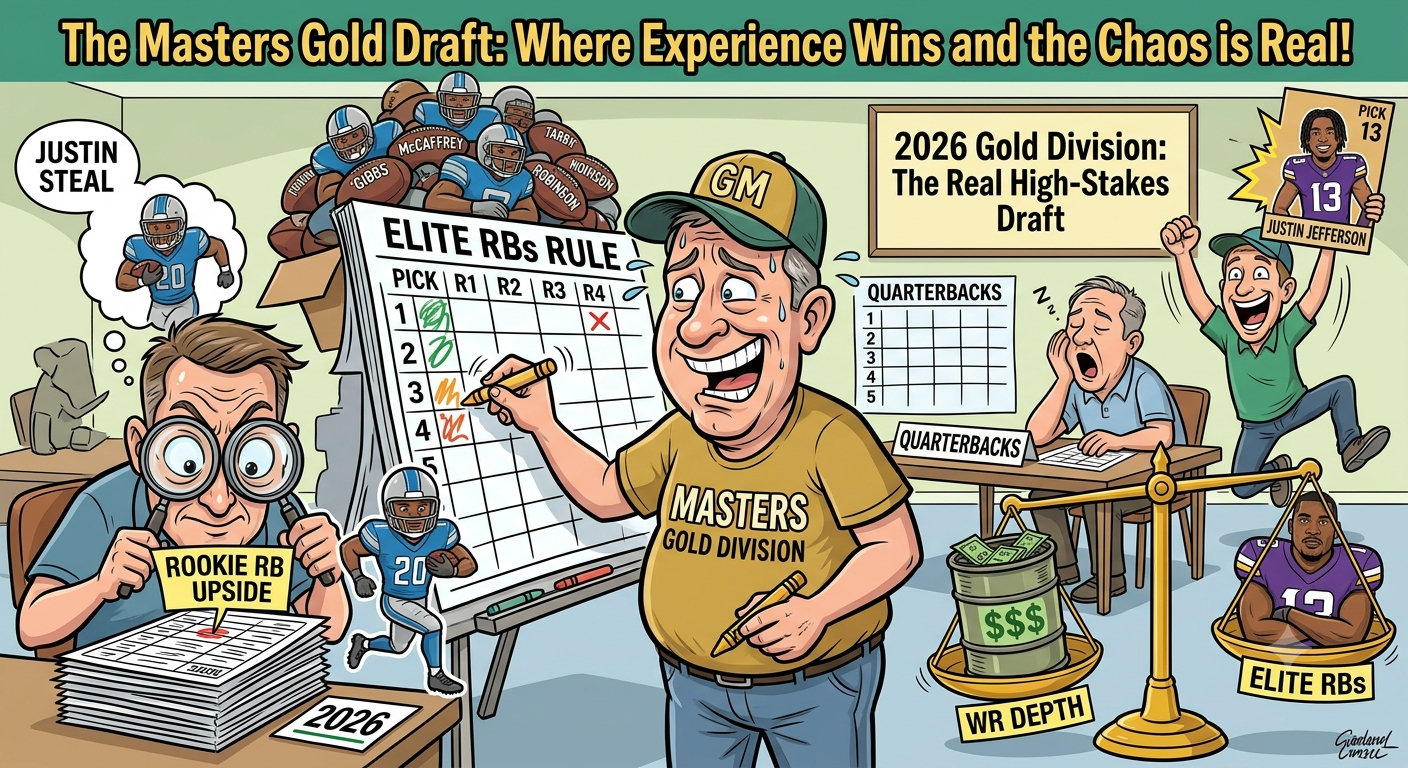
If there was one unmistakable takeaway from our first Gold Division draft, it was this: running backs ruled the first round. Seven of the first twelve selections were running backs. Early selections included Jahmyr Gibbs, Bijan Robinson, De’Von Achane, Christian McCaffrey, Jonathan Taylor, Chase Brown, and James Cook.
This wasn’t accidental. Experienced managers understand something many fantasy players forget every season: elite running backs disappear quickly. Wide receiver depth is stronger than it’s been in years, allowing managers to wait and still build excellent receiver rooms later. The same cannot be said for bell-cow running backs. Once the elite tier is gone, finding weekly difference-makers becomes significantly more difficult. That’s exactly what our Gold Division owners anticipated.
Trend #2: Quarterbacks Were an Afterthought
Perhaps the biggest surprise of the evening wasn’t who went early—it was who didn’t. Only Josh Allen cracked the first two rounds. After Allen came off the board in Round 2, quarterbacks virtually disappeared. Some notable selections included Josh Allen (Round 2), Lamar Jackson (Round 6), Caleb Williams (Round 7), Jayden Daniels (Round 7), Dak Prescott (Round 8), Jalen Hurts (Round 9), and Patrick Mahomes (Round 11).
That tells an important story. High-stakes fantasy managers continue embracing one of the strongest redraft strategies available: wait at quarterback. Rather than paying premium prices early, owners focused on securing scarce running backs and elite pass catchers before selecting quarterbacks capable of producing similar weekly ceilings several rounds later. When Lamar Jackson, Jalen Hurts, and Patrick Mahomes are all available well after Round 5, patience becomes incredibly rewarding.
Trend #3: Justin Jefferson at Pick 13 Might Be the Biggest Steal of the Draft
Sometimes the board simply falls your way. That happened for the manager drafting at the turn. Justin Jefferson slipped all the way to Pick 13 before finally hearing his name called. In many preseason rankings, Jefferson remains a top-five overall player. Landing him after an entire first round had already passed represents tremendous value.
These are exactly the kinds of opportunities experienced fantasy managers capitalize on. Instead of forcing positional needs, they allow value to come to them. When elite talent falls further than expected, they simply take the gift. Championship rosters are often built around moments like these.
Trend #4: Tight Ends Continue Becoming Difference Makers
Another noticeable trend was the aggressive pursuit of elite tight ends. Rather than waiting until the middle rounds, several managers secured players capable of creating weekly positional advantages. Early selections included Brock Bowers, Trey McBride, Colston Loveland, and Tyler Warren. Later value selections included George Kittle, Travis Kelce, Sam LaPorta, Dalton Kincaid, and Mark Andrews.
The position has evolved dramatically over the last several seasons. Instead of hoping for touchdown-dependent production, owners are targeting players capable of producing WR1 numbers from the tight end position. That weekly edge matters, especially in competitive high-stakes leagues where every matchup is closely contested.
Trend #5: Young Running Backs Are Already Being Trusted
One of the more fascinating developments was how comfortable experienced managers were drafting young running backs. Several second-year players came off the board surprisingly early, including Omarion Hampton, Cam Skattebo, TreVeyon Henderson, Quinshon Judkins, and Bhayshul Tuten, along with rookie Jeremiyah Love.
This illustrates an important shift. Fantasy managers no longer view young running backs strictly as developmental players. Instead, many see them as league-winning upside picks capable of becoming starters by October. When the opportunity presents itself, experienced owners are willing to invest before the breakout occurs. Finding one young back who exceeds expectations can completely transform a fantasy roster.
Trend #6: Veteran Stars Still Command Respect
Every offseason brings excitement surrounding young breakout candidates. Yet this draft showed that experienced fantasy players still trust proven production. Veterans selected surprisingly early included Derrick Henry, Mike Evans, Davante Adams, Travis Kelce, and Terry McLaurin.
While younger players often generate more offseason buzz, proven veterans continue providing weekly stability. In high-stakes leagues, consistency wins championships. Rather than chasing every breakout prediction, many owners preferred dependable production from players with established track records. That balance between youth and reliability often separates championship-caliber rosters from merely exciting ones.
Trend #7: Wide Receiver Depth Has Completely Changed Draft Strategy
For years, fantasy football managers were told the same thing: load up on wide receivers early. This draft told a different story. While elite receivers like Ja’Marr Chase, Puka Nacua, Jaxon Smith-Njigba, Amon-Ra St. Brown, and CeeDee Lamb still came off the board in Round 1, the depth at the position allowed managers to stay patient throughout the draft.
That kind of depth gives fantasy managers flexibility. Rather than feeling forced to draft multiple receivers early, experienced owners focused on securing scarce positions first before taking advantage of the incredible value that continued to fall at wide receiver. It’s another reason running backs dominated the opening round. The room understood there would still be quality receivers available for several more rounds.
Trend #8: Balance Beat Hero Builds
One of the biggest misconceptions in fantasy football is that championship rosters are built by taking extreme risks. That wasn’t the case in this Gold Division draft. Most owners built balanced, flexible rosters instead of chasing one particular strategy. Rather than loading up on quarterbacks or drafting four straight wide receivers, managers consistently mixed positions while allowing value to dictate their selections.
The result? Rosters with fewer weaknesses. Depth matters. In an 18-man roster format, injuries are inevitable and bye weeks are unavoidable. Having reliable contributors across every position often proves more valuable than having one dominant position and glaring holes elsewhere. This draft showed experienced owners weren’t trying to “win the draft.” They were trying to build teams capable of winning championships in December.
Trend #9: Experience Shows in High-Stakes Drafts
Perhaps the biggest takeaway had nothing to do with individual players. It was the discipline displayed throughout the room. There were very few panic selections, no massive quarterback runs, and very few reaches based purely on hype. Instead, owners consistently allowed the draft board to come to them.
That’s one of the biggest differences between casual leagues and high-stakes fantasy football. Experienced managers understand value. They know there are no trophies awarded for having the highest draft grade the morning after the draft. Championships are won by making dozens of smart decisions over the course of a season, beginning with a disciplined draft. When everyone in the room has experience, every round becomes more competitive. That’s exactly what makes our Gold Division drafts so much fun.
Trend #10: This Is Just the Beginning
The Gold Division always provides an excellent snapshot of how experienced fantasy football players are approaching the season. But it’s only the beginning. As more Gold Division drafts fill—and as Platinum and Titanium leagues begin drafting—we’ll continue tracking trends to see what changes and what stays consistent.
Will quarterbacks continue falling? Will rookie running backs climb even higher? Will elite tight ends become even more valuable? Will veteran receivers continue outperforming their ADP? We’ll be covering every major trend throughout draft season. If you’re drafting later this month, these live draft results provide one of the best indicators of where experienced fantasy managers believe the real value lies.
Biggest Steals of the Draft
Several selections stood out as tremendous values based on where they were selected:
- Justin Jefferson — Pick 13: Watching arguably the best wide receiver in football slide into the second round was one of the night’s biggest surprises.
- Lamar Jackson — Round 6: Waiting until Round 6 for one of fantasy football’s highest-ceiling quarterbacks illustrates exactly why patience at quarterback continues paying off.
- Jalen Hurts — Round 9: Finding an elite dual-threat quarterback in the ninth round is exactly the type of value that can separate playoff teams from championship teams.
- Brian Thomas Jr. — Round 6: One of the NFL’s most exciting young receivers lasted much longer than many expected and could end up being one of the best picks of the draft.
- Travis Kelce — Round 9: While younger tight ends have captured much of the offseason attention, Kelce still offers league-winning upside when healthy.
Biggest Surprises
Every draft has a few moments that leave the room talking. This one was no different:
- Running backs completely dominated Round 1.
- Only one quarterback was selected in the first two rounds.
- Justin Jefferson slipped into Round 2.
- Patrick Mahomes lasted until the 11th round.
- Several rookie running backs were selected ahead of established veterans.
- Tight ends remained a priority much earlier than many public rankings suggest.
These aren’t trends you’ll find in every home league, but they are exactly the kind of insights that come from experienced managers drafting with real money on the line.
Final Thoughts
Our first Gold Division Live Draft reinforced something we’ve believed for years: experienced fantasy football players don’t chase headlines—they chase value. They stay disciplined. They understand positional scarcity. They know when to wait. And perhaps most importantly, they build complete rosters instead of trying to “win” the first three rounds.
If your own draft is still ahead, there’s a lot to learn from these results. Whether it’s waiting on quarterback, taking advantage of wide receiver depth, investing in elite running backs early, or identifying falling values, this draft provided a roadmap that fantasy managers of every experience level can use. We’ll continue analyzing every Gold, Platinum, and Titanium live draft throughout the preseason, so be sure to check back for more strategy articles and draft breakdowns.
Ready to Play Against Serious Competition?
If you’re looking for a fantasy football experience where every owner is active, competitive, and invested from Week 1 through the fantasy playoffs, Masters Fantasy Football has a league for you. Our Gold, Platinum, and Titanium High-Stakes Redraft Leagues feature:
- Live Commissioner Support
- Experienced Fantasy Owners
- 18-Man Rosters
- Seven-Team Playoffs
- LeagueSafe Protected Funds
- No Hidden Fees
- Premium League Experience Since 2008
Whether you’re looking to test yourself against seasoned fantasy veterans or simply want a league that stays competitive all season long, we’d love to have you join us.
➡ Want to play for real money instead of just reading about it? Masters runs high-stakes redraft fantasy football leagues in Gold, Platinum, and Titanium divisions. Each one is a true standalone 12-team league, so your prize pool is funded by your own league and not diluted across thousands of national entries. All entry fees and payouts are held securely through LeagueSafe.
Frequently Asked Questions
When do Masters Fantasy Football Gold Division drafts take place? Gold Division live drafts begin before the NFL season and continue throughout August and September as leagues fill. Multiple draft dates and times are available.
What makes a high-stakes fantasy football draft different? Managers tend to draft more strategically because every decision has real financial implications. That leads to fewer reaches, better roster construction, and more competitive leagues.
Why were running backs drafted so aggressively? Elite running backs are difficult to replace during the season, while quality wide receivers remain available much deeper into drafts.
Why did quarterbacks fall so far? The depth at quarterback allows experienced managers to wait several rounds while still landing high-end fantasy production.
Is this draft a good indicator of current fantasy football ADP? Live high-stakes drafts often provide a more realistic picture of player values than mock drafts because every owner has real money invested.
What roster size do Masters Redraft leagues use? Masters High-Stakes Redraft Leagues feature 18-man rosters, creating deeper drafts and rewarding owners who identify quality depth.
How many teams make the playoffs? Seven teams qualify for the fantasy playoffs, with the No. 1 seed earning the lone first-round bye.
Are these leagues commissioner managed? Yes. Masters Fantasy Football provides commissioner support throughout the season to ensure leagues run smoothly.