
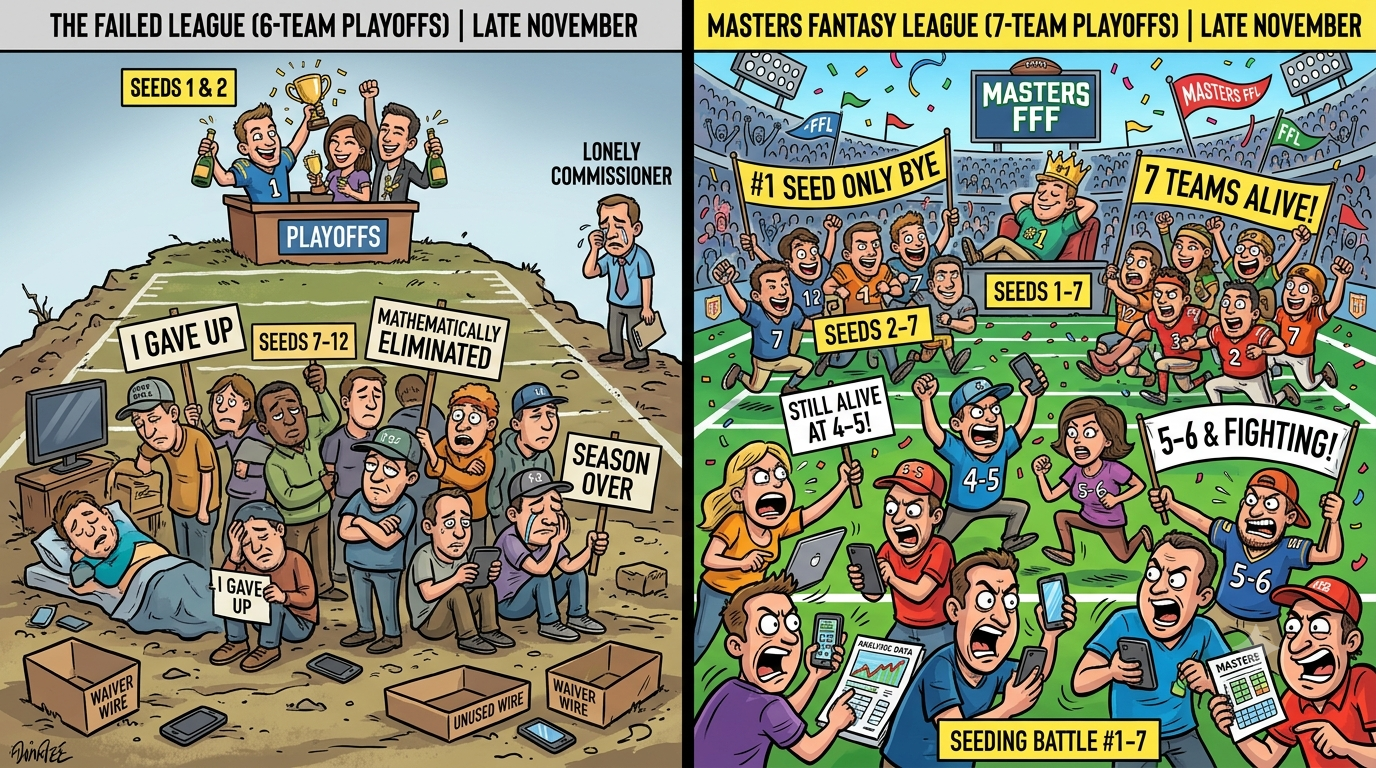
Fantasy football is at its best when every owner has a meaningful reason to stay competitive deep into the season. Unfortunately, most traditional redraft leagues lose steam by mid-season. A few strong teams pull ahead, while others fade, leading to quiet waiver wires, neglected lineups, and disengaged owners. By late November, half the league is just going through the motions.
The main culprit? Playoff formats that eliminate too many teams too early.
At Masters Fantasy Football Leagues, we’ve spent years refining structures that keep owners fully invested from Week 1 through the championship. Our seven-team playoff format keeps more than half the league alive late in the season while preserving strong incentives for regular-season performance — and it’s one of the key reasons our redraft leagues stay competitive when others go quiet.
The Problem with Smaller Playoff Fields in Redraft Leagues
Most redraft leagues use a six-team playoff format. On paper, it rewards the top teams. In reality, it leaves half of a 12-team league without a postseason path. By Weeks 8–10, owners facing injuries, tough schedules, or slow starts already feel mathematically eliminated.
The consequences are predictable: reduced waiver activity, minimal lineup effort, and growing inactivity. Early elimination kills the competitive energy that makes fantasy football worth playing.
How a Seven-Team Playoff Format Keeps Redraft Leagues Competitive
A seven-team playoff format dramatically improves the experience by giving more than half the league a realistic shot at the championship. Teams sitting at 4-5 or 5-6 in November remain very much in the hunt. A winning streak, smart waiver pickups, or a breakout performance can quickly transform a fringe team into a legitimate contender.
The result is sustained engagement across the entire league:
- Higher waiver wire activity every week
- More competitive lineup decisions through the final regular-season games
- Greater overall participation deep into December
When more owners stay invested late in the season, everyone benefits from sharper competition and better fantasy football.
Ready to Join a League That Stays Competitive All Season?
Seven-team playoffs. Active waivers. Live commissioners. All-in pricing. Masters has been doing it right since 2008.
Only the #1 Seed Gets a Bye — Here’s Why That Matters
We believe in rewarding excellence without diluting the regular season. That’s why only the #1 seed receives a first-round bye in our playoff format. No one else gets an automatic pass.
Why reward the #2 seed with a free path to the semifinals? They should have to win a first-round matchup like everyone else. This structure keeps the race for the top seed highly competitive through the final regular-season weeks — and ensures every playoff advancement is truly earned.
Seeding Battles Stay Meaningful
In many leagues, simply qualifying for the playoffs causes motivation to drop. At Masters, making it is only the beginning. The fight for better seeding — especially that #1 spot with its bye — keeps playoff-bound teams competing hard in the final weeks instead of coasting. That creates an extra layer of strategy and weekly stakes that most redraft formats simply don’t have.
Fewer Abandoned Rosters, Fewer Free Wins
One of the most frustrating experiences in redraft fantasy football is earning a playoff spot and then drawing an opponent who stopped managing their team weeks ago. With seven teams still alive deep into the season, far fewer owners check out early. Active rosters produce more legitimate, skill-based matchups — and fewer “free wins” that undermine competitive fairness.
Seven-Team Playoffs Work Best as Part of a Complete System
The seven-team playoff format delivers the most value when paired with the right league structure. At Masters, we combine it with 18-man rosters, which keeps the waiver wire dynamic all season long. Owners can’t simply hoard talent — the tighter roster limit creates real decisions every week and ongoing opportunities for smart moves.
Together, these elements consistently deliver:
- Championship paths for more than half the league
- Active waiver strategy from Week 1 through the playoffs
- Meaningful games right up to the end of the regular season
Frequently Asked Questions
What is a seven-team playoff format in fantasy football?
A seven-team playoff format sends the top 7 teams in a 12-team redraft league to the postseason. Only the #1 seed receives a first-round bye. The remaining six seeds all compete in the opening round, keeping seeding battles intense and giving more than half the league a genuine championship path.
Why are seven-team playoffs better than four-team or six-team playoffs?
Seven-team playoffs keep more owners motivated deeper into the season. Compared to smaller formats, they reduce early eliminations, sustain waiver wire activity, and produce more competitive redraft leagues from start to finish.
Does giving only the #1 seed a bye make the regular season less important?
No — it makes the race for the top seed more important. Because only one team earns a bye, every win in the final weeks of the regular season matters. Seeds #2 through #7 still have to earn their way to the championship through actual matchups.
How does a seven-team playoff format affect waiver wire activity and owner engagement?
It keeps engagement significantly higher. With more teams still alive, owners stay active on waivers, make sharper lineup decisions, and compete harder — especially when paired with 18-man rosters that keep free agency meaningful all year.
What makes Masters Fantasy Football Leagues different from other paid redraft leagues?
Masters combines a seven-team playoff format, 18-man rosters, live commissioners, LeagueSafe prize protection, and transparent all-in pricing to create one of the most competitive and consistently active redraft experiences available since 2008.
Why Owners Keep Coming Back to the Masters Seven-Team Playoff Format
New owners notice the difference immediately: tighter standings, active playoff races, and real league engagement well into December. Owners who might have checked out in a traditional redraft league stay invested at Masters — battling for seeding, chasing titles, and competing every single week.
That’s not luck. It’s the result of thoughtful, owner-focused league design built over nearly two decades.
The Masters Redraft Advantage
The best redraft fantasy football leagues keep every owner engaged from draft day through the championship. Our seven-team playoff format — with only the #1 seed earning a bye — achieves exactly that.
Instead of just four teams fighting in December, more than half the league remains fully invested and competing for a title. That’s the standard Masters has held since 2008.
Ready to experience the difference? Learn more about the full Masters redraft experience: Not All Redraft Fantasy Football Leagues Are Created Equal: The Masters Difference Since 2008. Discover how active waivers, live commissioners, transparent all-in pricing, and smarter league design create one of fantasy football’s most engaging redraft experiences.