
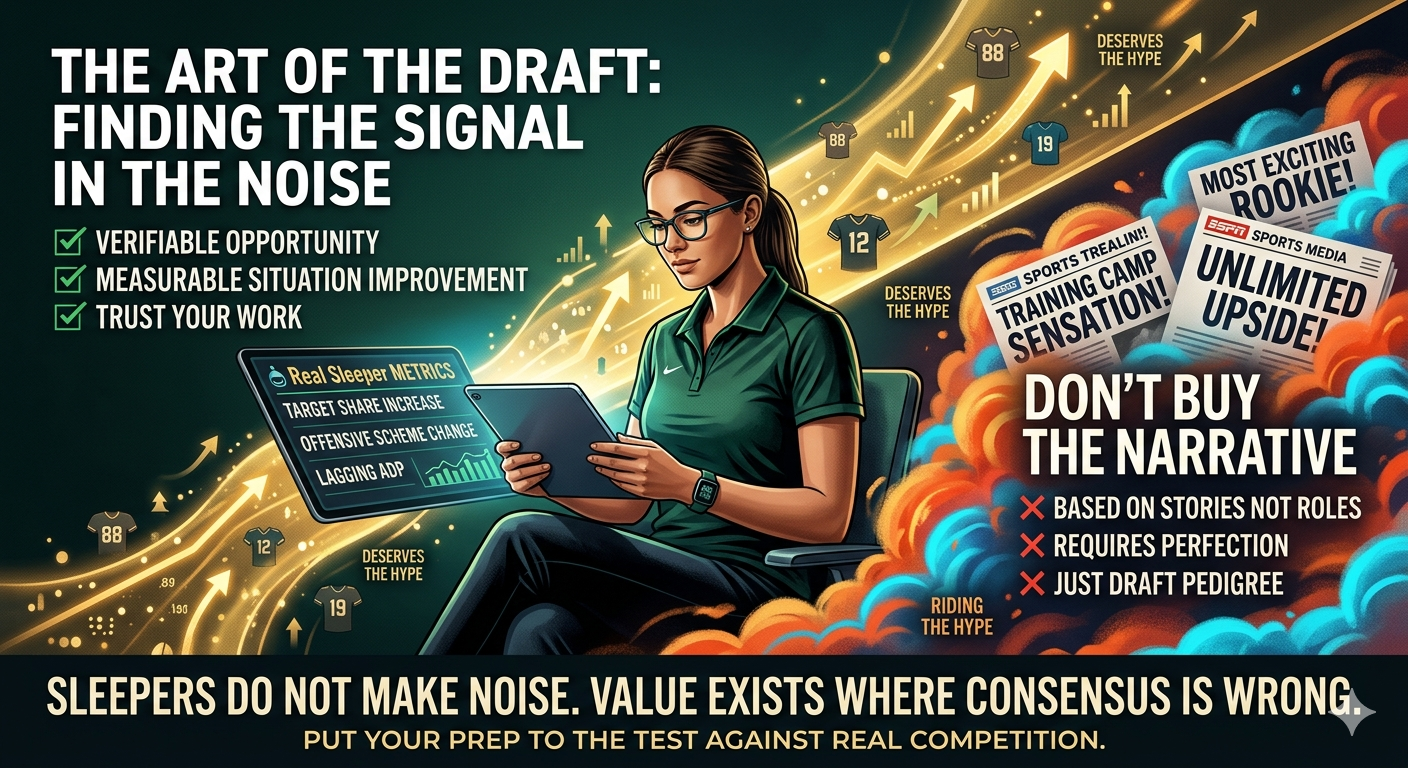
Every fantasy draft has two kinds of names trending up the board right now — players who deserve the hype and players who are simply riding it. The difference between the two will decide more leagues than any other single draft decision you make. Get it right and you are walking away with a roster full of underpriced value while the rest of your league overpays for noise. Get it wrong and you have burned mid-round picks on names that sounded great in June but deliver nothing by October. The managers who win redraft leagues are almost never the ones who drafted the biggest stars — they are the ones who knew which rising names were real and which ones were just loud.
Why This Distinction Matters More in Redraft Than Dynasty
In dynasty, a wrong bet on a hyped name is rarely fatal. If the player doesn’t pan out, you hold him another season, package him in a trade, or let him ride your bench while the role clarifies. Dynasty gives you time, and time forgives mistakes.
Redraft offers none of that cushion. The roster you build right now is the roster you are living with for the next several months, and every spot spent on a name driven by hype rather than opportunity is a spot you cannot use on someone who will actually produce. There is no “we’ll see how it develops.” There is only Week 1, and the bill comes due immediately.
This is why the sleeper-versus-trap distinction carries more weight in redraft than almost anywhere else in fantasy. A dynasty manager who reaches on a hyped name right now can absorb the loss across a multi-year window. A redraft manager who reaches on that same name in the 6th round right now has effectively burned a pick before the season even begins if that hype was never backed by real opportunity.
The good news is that the signals separating real sleepers from traps are almost always visible right now — you just have to know what to look for instead of what to listen to.
The Three Signals of a Real Sleeper
The word sleeper gets thrown around so loosely in fantasy coverage that it has almost lost its meaning. By the time a name is showing up on every sleeper list on every major platform, it is no longer a sleeper — it is just a player the market has already priced in. A real sleeper is a player whose opportunity has legitimately improved but whose ADP has not caught up yet. There are three signals that tell you the difference.
Something verifiable has changed about their opportunity. Not a quote. Not a feeling. Not a beat writer’s enthusiasm from a May practice. An actual, concrete change — a starter retired, a top receiver was traded away, a depth chart shifted in a documented way. If you cannot point to a specific event that created volume for this player, the opportunity is not real yet. It is projected. Projections are not facts.
Their situation has measurably improved. A new offensive coordinator with a track record of feeding a specific position. A quarterback upgrade that turns a mediocre passing game into a legitimate one. An offensive line that quietly got better through free agency. These are the kinds of structural changes that drive real statistical improvement, and they are almost always hiding in plain sight while the fantasy community is busy chasing louder stories.
Their ADP is still lagging the opportunity. This is the most important signal of all. If the change is real but the market has not fully reacted yet, you have found genuine value. A player whose situation improved in March but whose ADP still reflects his role from last season is exactly what you are looking for. The window does not stay open forever — as draft season heats up, the market tends to correct — but right now there are players sitting at prices that do not reflect what their role actually looks like heading into the season.
When all three signals are present, you are not chasing hype. You are buying value before everyone else figures it out.
The Three Signals of a Trap
Traps are more dangerous than bad players. A bad player is easy to avoid — nobody is telling you to draft him. A trap is a player the entire fantasy community has convinced itself is about to break out, which means his ADP is climbing, his name is everywhere, and the social pressure to roster him is real. By the time you are sitting in your draft and his name comes up three rounds earlier than it should, it feels wrong to pass. That feeling is exactly what the trap is counting on.
The hype is built on narrative rather than role. This is the most common trap signal and the easiest to miss because the narratives are usually compelling. A skill position player gets a new quarterback and suddenly every analyst is projecting a monster season. A running back shows up to training camp in the best shape of his life — a phrase that has predicted almost nothing in the history of fantasy football. A receiver gets a glowing quote from his offensive coordinator in June. None of these things are facts about opportunity. They are stories, and stories do not score points.
The breakout requires multiple things to go right simultaneously. A real sleeper needs one thing to happen. A trap usually needs three or four. The starting running back has to get hurt. The offensive coordinator has to actually feature this player the way the beat reporters are suggesting. The quarterback has to stay healthy. The scheme has to change from what it was last season. Every additional condition required for the hype to pay off is another reason the ADP is not justified. When you find yourself constructing a multi-step argument for why a player is going to produce, stop and ask whether you are analyzing or rationalizing.
Name recognition or draft pedigree is doing the heavy lifting. Former first-round picks are the most reliable trap in fantasy football. The NFL draft capital argument — “he was a top-ten pick, the talent is there” — has cost more fantasy managers more points than almost any other flawed logic. What a player was drafted to become and what he actually is right now are two completely different things. If the primary case for a player is what he was supposed to be rather than what his current role actually looks like, his ADP is built on hope and not opportunity.
When you see all three of these signals on a player trending up your board, the right move is almost always to let someone else pay the price.
The Green Bay Packers: The Perfect Case Study
Sometimes one NFL receiver room tells the entire sleeper-versus-trap story better than any abstract framework could. The Green Bay Packers heading into this season are exactly that room.
Last offseason, Romeo Doubs led the Packers with 55 receptions, 724 yards and 6 touchdowns before leaving for New England in free agency. Dontayvion Wicks, who had averaged 4.5 targets per game in 2024, saw that number fall to 3.3 in 2025 and was eventually traded to Philadelphia for Day 3 picks. Two of the four receivers who crowded the room last year are simply gone. That is a verifiable, concrete change in target availability — exactly the kind of signal a real sleeper opportunity is built on.
Enter Matthew Golden. The Packers used a first-round pick — the 23rd overall selection in 2025 — on Golden, the first receiver they had drafted in the first round in over two decades. He ran a 4.29 forty at the Scouting Combine, the fastest time posted by any offensive player in that draft class, putting him in the 99th percentile of NFL athletes at his position. His rookie numbers were modest: 29 receptions, 361 yards, zero touchdowns on 44 targets across 14 games. But context matters enormously. Golden was buried behind Watson, Doubs, Reed and Wicks in a room that simply could not get everyone enough volume. The targets were not there. Now two of those four competitors are gone and the Packers have publicly stated their intention to get Golden more involved in his second season.
So is Matthew Golden a sleeper? On paper, all three signals are present. Verifiable opportunity opened up. His situation has measurably improved. His ADP still reflects a player coming off a quiet rookie year rather than a player entering a dramatically different target landscape.
Here is where it gets complicated — and this is exactly where the checklist earns its value.
The Packers just handed Christian Watson a 4-year, $110.5 million extension. Watson averages 17.0 yards per catch since entering the league and produces at a legitimate WR1 level when healthy. Jayden Reed then signed a 3-year, $50.25 million extension, cementing his role as the slot anchor Jordan Love depends on for third-down conversions. That is $160 million invested in two receivers who are absolutely not moving out of the way for anyone.
So flip the question entirely: what if Matthew Golden is not the sleeper in this room? What if Golden — the electric first-round pick with the 4.29 speed and the breakout narrative — is actually the trap, and the real sleepers are Watson and Reed?
Both are entering seasons with extensions just signed, motivated, healthy, and locked into defined roles in a Jordan Love offense that is maturing. Watson is undervalued because his counting stats have been suppressed by injury and a crowded room. Reed is undervalued because casual fantasy managers see a slot receiver and underestimate his volume. Golden is getting drafted on upside and hype in a room where two entrenched veterans just got paid to be the priority targets.
That is the trap hiding in plain sight. The loudest name in the room is not always the right name.
Ready to put your draft instincts to the test against serious competition? At Masters Fantasy Football Leagues we have been running competitive redraft, dynasty, and auction leagues for 19 years and have never folded a single league. All prize funds are secured through LeagueSafe and our all-in pricing means no hidden fees — ever.
The Checklist: Apply This to Any Riser on Your Board
Every preseason creates a wave of names trending up draft boards. Some deserve it. Most do not. Before you reach for any player whose ADP has climbed since last season, run through these five questions. They will not make the decision for you — but they will force you to separate what you know from what you have been told.
1. Has something factually changed about their opportunity?
Not a quote. Not a feeling. Not a beat writer’s enthusiasm from a May practice. A concrete, verifiable event — a starter left in free agency, a trade happened, a depth chart shifted in a documented way. If you cannot point to a specific event that created volume for this player, the opportunity is not real yet. It is projected. Projections are not facts.
2. Is the situation measurably better or just narratively better?
A new offensive coordinator is only a signal if that coordinator has a track record of feeding a specific position. A quarterback upgrade only matters if the upgrade is real and not just an opinion. Ask yourself: what specific, documented change makes this player’s situation better than it was twelve months ago? If the answer is “people are excited about him,” that is not a situation upgrade. That is noise.
3. Does their ADP reflect the opportunity or the hype?
Pull the player’s ADP from last season and compare it to where he is going now. If the ADP has climbed dramatically but the factual situation has only changed modestly, the market has gotten ahead of reality. If the ADP is still lagging a genuine opportunity shift, you have found value. The question is always whether the price reflects what is actually true or what people hope will be true.
4. Would you still want this player if nobody was talking about him?
This is the most honest question on the list and the hardest one to answer truthfully. Strip away the podcast takes, the fantasy Twitter consensus, the analyst rankings, and the training camp buzz. If this player showed up on your draft board in complete silence — no hype, no narrative, just the facts of his role and situation — would you still want him at his current ADP? If the answer is no, you are buying the story and not the player.
5. Who is in the way?
A player’s opportunity is never evaluated in isolation. It always exists inside a depth chart, a target share, and an offensive philosophy. Before you draft anyone based on opportunity, map out every player ahead of them, beside them, and competing with them for the same volume. The Green Bay example makes this point clearly — Golden’s opportunity looks real until you account for $160 million worth of receivers who have been contractually confirmed as the priority targets. The opportunity signal was real. The target ceiling was not what the hype suggested.
Run every rising name on your board through these five questions before your draft. The managers who do this work now are the ones sitting at the top of their league standings in November wondering why everyone else got it wrong.
Why Patience Beats Hype
There is a version of every fantasy draft where the room gets caught up in the moment. A name comes off the board two rounds earlier than expected and suddenly everyone is scrambling to grab the next hyped player before they miss out too. The managers who stay patient while that is happening are the ones who end up with rosters built on reality instead of reaction.
The market almost always overcorrects on offseason buzz. When a player’s name starts appearing on every sleeper list in June, his ADP climbs to reflect the enthusiasm of analysts and managers who have been consuming the same content and arriving at the same conclusions. By the time you sit down at your draft, the player who was genuinely undervalued in March has often been fully priced in — or overpriced — simply because enough people talked about him loudly enough for long enough.
This is why the checklist matters more than the consensus. The consensus is a reflection of what everyone already knows, or thinks they know. It moves on narrative, on highlights, on the loudest voices in the room. Value in fantasy drafts exists precisely where the consensus has not caught up to reality, or where the consensus has run so far ahead of reality that it has created a trap hiding in plain sight.
Patience in a draft means trusting the work you did before you sat down. It means knowing which players pass the five-question checklist and which ones only pass the smell test. It means letting the room reach for the name everyone has been talking about while you take the player whose situation actually changed but whose story never got told loudly enough to inflate his price.
The managers who win redraft leagues are not the ones who drafted the most exciting roster right now. They are the ones who drafted the most accurate roster — the one built on what is actually true about each player’s role, situation, and target landscape heading into the season.
Sleepers do not make noise. That is the point. If everyone already knows about it, it is not a sleeper anymore. Your job right now, before your draft, is to find the names that deserve to be louder than they are — and avoid the names that are already louder than they deserve to be.
Put Your Draft Prep to the Test
At Masters Fantasy Football Leagues, we have been running competitive redraft, dynasty, and auction leagues for 19 years and have never folded a single league. The managers who thrive in our leagues year after year are the ones who do exactly what this article describes — they show up to their draft with a plan built on facts, not noise, and they trust that plan when the room starts chasing hype in the wrong direction.
If you are ready to put your draft preparation to the test against serious competition, we have leagues at every price point waiting for you. All prize funds are secured and segregated through LeagueSafe, and our all-in pricing means no hidden fees at checkout — ever.
Browse Available Leagues at Masters Fantasy Football Leagues