
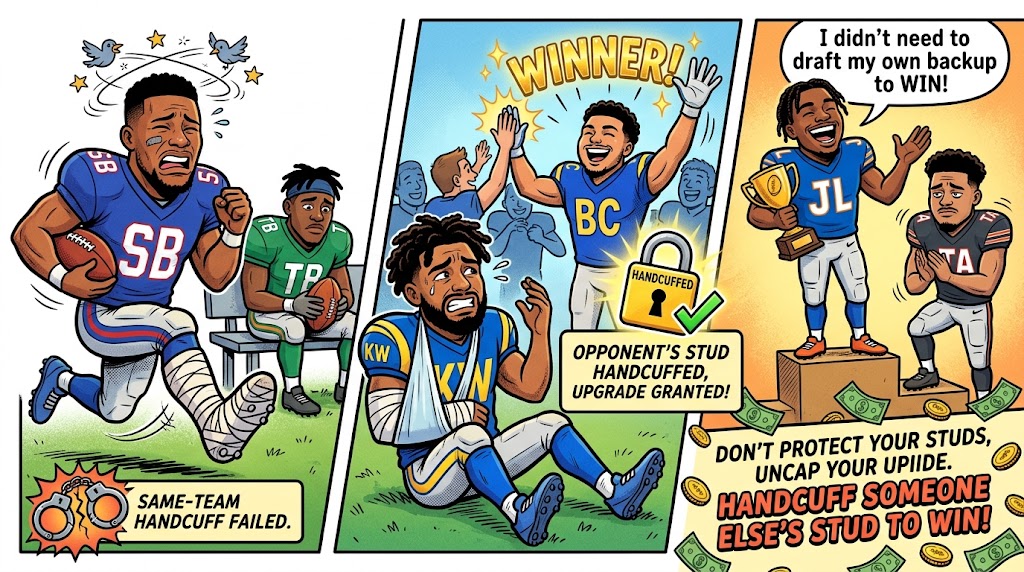
Every August, the same advice gets repeated in every mock draft chat, every podcast, every group text: “Draft your stud’s handcuff.” Got Saquon Barkley? Grab Tank Bigsby. Got Kyren Williams? Grab Blake Corum. Got D’Andre Swift? Grab Kyle Monangai. Got Jeremiyah Love? Grab Tyler Allgeier.
It sounds airtight. Protect your investment. Don’t let one injury sink your season. It’s Fantasy Football 101.
It’s also, more often than not, the wrong play if your actual goal is to win a championship.
The Handcuff Logic, and Where It Breaks
The idea behind handcuffing your own stud is simple: if he goes down, you already own the guy who inherits the touches, so you don’t have to scramble on waivers. That part is true. What it doesn’t do is make your team better. At absolute best, a same-team handcuff gives you a floor equal to what you already had. At worst — and this is the far more common outcome — it gives you a floor that’s meaningfully below what you already had, because backups are backups for a reason.
Think about the math. You spend a bench spot, and often a mid-round pick, on a player whose entire value proposition is “he might replace a player I already own.” If Saquon Barkley stays healthy, Bigsby is a wasted roster spot all year. If Saquon gets hurt, you’re not gaining anything — you’re just softening the blow of losing arguably the best running back in football. You went from “elite RB1” to “replacement-level committee back.” That’s not protection. That’s managing a loss.
Now flip it. Say you don’t own Kyren Williams at all — you drafted Blake Corum anyway, late, as a dart throw. If Kyren stays healthy, you’re out nothing but a bench spot. If Kyren goes down, you didn’t lose anything you were counting on, because you were never counting on the Rams backfield in the first place. What you gained is a potential league winner sitting on your bench who cost you almost nothing. Your team didn’t get worse. It got better, because you added an asset with real spike-week upside for the price of a late-round dart throw.
That’s the entire argument in one sentence: handcuffing your own stud caps your downside at “still bad.” Handcuffing someone else’s stud uncaps your upside at “league winner, for free.”
This Is the Moneyball Play
If you want to win, and not just avoid disaster, the correct approach isn’t to draft Bigsby to protect Saquon. It’s to draft Corum, Monangai, Allgeier — the backups to somebody else’s workhorse — and let that be your actual upside swing.
Here’s why this matters so much: if your first-round running back goes down for an extended stretch, you probably aren’t winning your league anyway. Doesn’t matter who you drafted behind him. Saquon Barkley isn’t just a name — he’s a top-five talent getting a bell-cow workload behind a good offensive line. Nobody on his own bench replaces that production. You can cushion the fall, but you can’t replace a top-five overall player with a Day 3 rookie or camp body, no matter how well he plays. Your ceiling for the season just took a real hit, and no handcuff changes that fact.
But if someone else’s first-round stud goes down — a stud you don’t own — and you happen to be sitting on his direct replacement, your championship equity doesn’t just get cushioned. It skyrockets. You get a potential league winner added to your active roster, and your team is stronger today than it was yesterday. That’s the entire Moneyball principle applied to fantasy roster construction: find value where the market isn’t pricing it, and stack asymmetric bets where the downside is capped near zero and the upside is a title.
The History Backs This Up
This isn’t a theory. It’s happened over and over, and the list of backups who turned into legitimate league winners is long.
Devonta Freeman entered 2015 as an afterthought behind rookie Tevin Coleman in Atlanta. Coleman got hurt in Week 2, Freeman took over, and by the end of the year he’d racked up over 1,600 total yards and 14 touchdowns — the overall RB1 in fantasy. Nobody drafted Freeman as “insurance” for Coleman. He was a value pickup that turned into a championship engine.
Spencer Ware stepped in for an injured Jamaal Charles in Kansas City in 2016 and put up 921 rushing yards and over 1,300 total yards, finishing as a top-16 running back off almost nobody’s radar in August.
James Conner took over for a holdout Le’Veon Bell in Pittsburgh in 2018 and finished as the overall RB6, scoring 13 total touchdowns in just 13 games. Managers who grabbed him cheap didn’t just avoid disaster — they won titles with him as their RB1.
Alvin Kamara himself started his career as change-of-pace insurance behind Mark Ingram in New Orleans, and by midseason of his rookie year he was outproducing Ingram and turning into one of the most explosive fantasy assets in the league — for whoever was smart enough to grab him.
C.J. Anderson was out of a job in November 2018, signed by the Rams when Todd Gurley’s knee flared up, and dropped 167 rushing yards in a playoff game that carried fantasy rosters into and through their championship weeks. Nobody drafted him in August. He was a pure waiver-wire Moneyball play that materialized exactly when it mattered most.
Austin Ekeler spent his rookie season as a complementary piece behind Melvin Gordon in the Chargers’ backfield and turned into one of the most valuable weekly fantasy assets in the league — a player almost nobody paid a real draft cost for, who ended up outproducing the stud he was supposedly “handcuffing.”
Notice the pattern. None of these breakouts made the guy who drafted the injured starter feel better about his own team. They made the guy who was smart enough to also own the backup — often for pennies, often not even connected to the injured starter’s original owner — into a champion.
What To Actually Do This Year
So skip the same-team handcuff. If you have Saquon Barkley, don’t waste a pick on Bigsby hoping to soften a blow that would sink your season no matter what. Use that pick on Blake Corum, or Kyle Monangai, or Tyler Allgeier — backups to other teams’ workhorses. Best case, that pick is a bench player who costs you nothing all season. Better case, one of those backfields breaks open in October and you’ve got a league winner already rostered, stealing him right out from under everyone who spent the last two months holding him for someone else.
Protecting your studs feels responsible. But fantasy football isn’t won by feeling responsible — it’s won by stacking bets where you can’t really lose and the payoff can carry your whole season. Grab your handcuff if it makes you feel better. But if you actually want to win, draft someone else’s.
Put This Strategy to Work in a Live Draft This Week
The only way this strategy actually pays off is if your league is deep enough, and competitive enough, that these backfield breakouts matter. Masters Fantasy Football Leagues has over 300 live snake drafts filling over the final two weeks before kickoff, across seven price points ranging from $50 to $3,000, so there’s a division that fits your budget and your bankroll. Check the full live draft schedule here and grab a seat before the boards fill.
Every division runs on all-in pricing — no hidden fees, no surprise charges buried at checkout — and every prize pool is protected through LeagueSafe, so the money you’re playing for is actually the money you get paid when you win. Masters has been running competitive, paid fantasy football leagues for nearly 20 years without ever folding a league, which is the only track record that actually matters when you’re deciding where to trust your entry fee.
Frequently Asked Questions
What is a fantasy football handcuff?
A handcuff is the backup running back who would take over the lead role if the starter in front of him gets hurt. The term usually refers to drafting that backup specifically to protect an running back you already own.
Should I draft my own running back’s handcuff?
Generally, no — not if your goal is to maximize your chance of winning a championship. Drafting your own stud’s handcuff only protects a floor you already had; it doesn’t raise your team’s ceiling. A better use of that roster spot is a backup to a workhorse on another team, which adds pure upside with almost no downside.
What’s the better handcuff strategy?
Target backups to other teams’ lead running backs instead of your own. If that back gets hurt, you’ve added a potential league winner to your active roster for the cost of a late-round pick. If he stays healthy, you’ve lost almost nothing.
Are handcuffs worth a roster spot in fantasy football?
Sometimes, but usually only the handcuffs to other teams’ bell-cow backs, not your own. A same-team handcuff mostly sits dead on your bench all season and only matters in the worst-case scenario, where it still leaves your team worse off than before the injury.
Where can I join a live fantasy football draft before the season starts?
Masters Fantasy Football Leagues is running over 300 live snake drafts across the final two weeks before kickoff, in seven price points from $50 to $3,000. Full dates and divisions are on the live draft schedule.
Is my money safe in a paid fantasy football league?
At Masters, yes. All prize funds are held through LeagueSafe, all pricing is all-in with no hidden fees, and if you choose a dynasty league over a redraft: We have never folded a dynasty league in nearly 20 years of operation.