
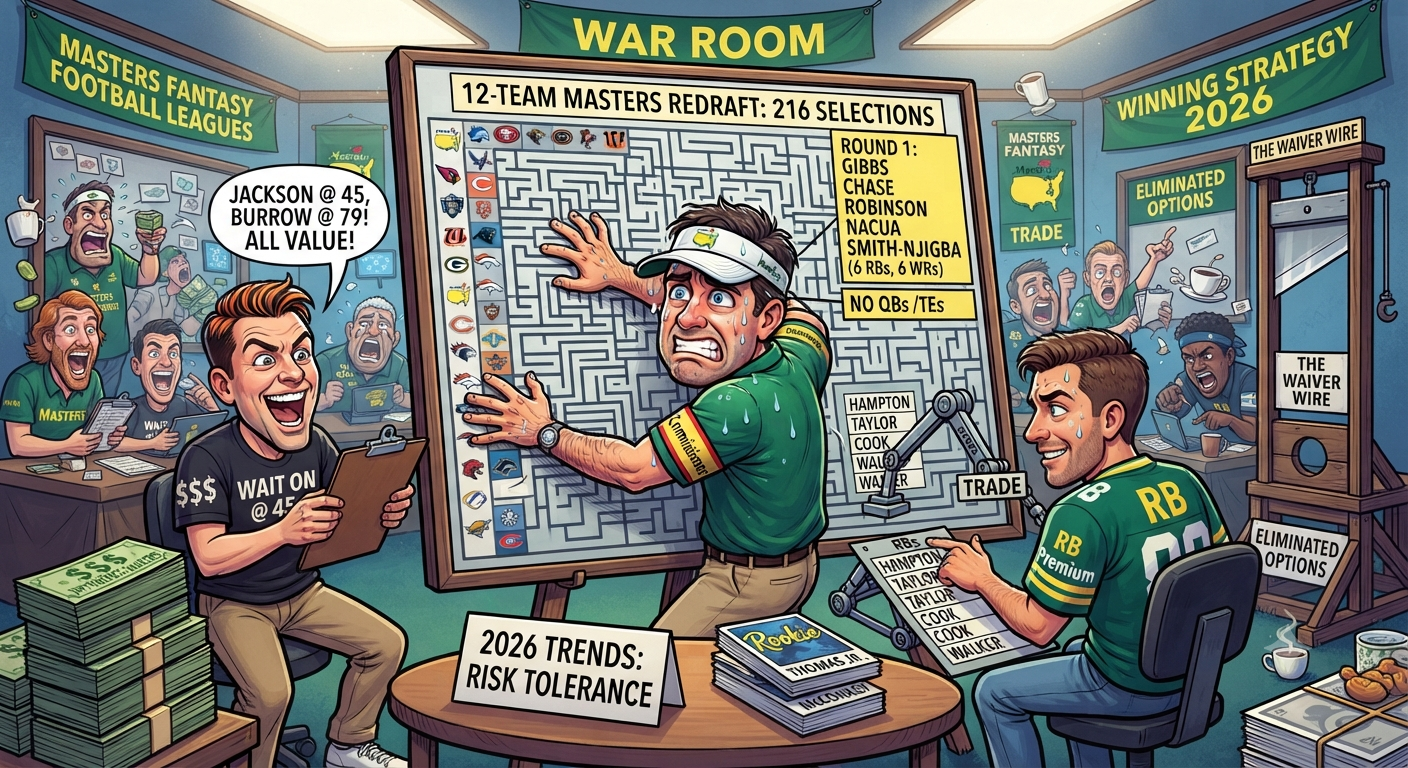
Every fantasy football draft tells a unique story about winning fantasy football strategy. In competitive leagues like the Masters Fantasy Football redraft, experienced managers balance elite talent, positional scarcity, upside, risk, and roster construction across 18 rounds.
This 12-team Masters redraft league offers powerful insights into current fantasy football draft trends, especially for redraft formats. With 216 total selections, the draft data reveals clear patterns in when managers invested in quarterbacks, running backs, wide receivers, tight ends, and more.
Final draft position totals: 74 wide receivers, 65 running backs, 25 quarterbacks, 26 tight ends, 13 defenses, and 13 kickers.
First Round Breakdown: Elite RBs and WRs Dominate Early Fantasy Football Strategy
The first round set the tone for strong fantasy football foundations:
- Jahmyr Gibbs
- Ja’Marr Chase
- Bijan Robinson
- Puka Nacua
- Christian McCaffrey
- Jaxon Smith-Njigba
Key takeaway: All 12 first-round picks were split evenly between six elite running backs and six elite wide receivers. No quarterbacks or tight ends were selected in Round 1.
This illustrates a core draft strategy: prioritizing high-upside skill position players who deliver weekly positional advantages. Managers avoided reaching for QBs early despite the growing popularity of quarterback-heavy builds. The first quarterback, Josh Allen, didn’t come off the board until pick 25.
Waiting on Quarterback: The Biggest Strategic Edge in 1QB Leagues
One of the clearest strategies emerging from this Masters redraft is waiting on quarterback.
- Josh Allen: Pick 25
- Lamar Jackson: Pick 45
- Drake Maye: Pick 74
- Joe Burrow: Pick 79
- Jalen Hurts: Pick 81
- Jayden Daniels: Pick 89
Want the full breakdown of exactly how this QB drought unfolded — including the surprise Drake Maye pick that broke it open? Read Why Waiting on Quarterback Is One of the Smartest Fantasy Football Draft Strategies in 1QB Redraft Leagues for a deep dive into this exact strategy.
This created a massive value window. Managers could comfortably build elite RB/WR cores through the first 4–5 rounds before addressing QB.
In standard 1QB leagues, the drop-off from elite QBs to strong starters is often smaller than the gap at RB or WR. Waiting on QB allows drafters to secure more difference-makers early, then grab high-upside quarterbacks later. This league proved that approach is still highly viable in 2026 fantasy football.
Running Backs Remain Premium: Early Investment Pays in Redraft Leagues
Despite shifting NFL trends, running backs stayed highly valued, with heavy concentration in the first two rounds. Notable early RBs included Jahmyr Gibbs, Bijan Robinson, Christian McCaffrey, Omarion Hampton, Jonathan Taylor, James Cook, Ashton Jeanty, Kenneth Walker, De’Von Achane, Saquon Barkley, Chase Brown, and Derrick Henry.
Top managers mixed proven veterans with high-upside young backs. Age wasn’t the deciding factor — expected 2026 production was. This balanced approach works especially well in redraft leagues where you only need one championship season.
Wide Receivers: The Deepest Position with Massive Early Investment
Wide receiver was the most-selected position, reflecting the depth and weekly upside available at the position. Early WRs included Ja’Marr Chase, Puka Nacua, Jaxon Smith-Njigba, Amon-Ra St. Brown, Justin Jefferson, and CeeDee Lamb. By the end of Round 3, 16 wide receivers were already off the board.
Loading up on elite WRs early can create a massive weekly advantage, but it must be balanced against RB scarcity. The league showed managers are comfortable investing heavily in WRs because of the position’s consistent production and explosive ceiling.
Tight End Strategy: Tier-Based Approach Wins
Tight end followed a clear tiered strategy:
- Elite tier: Brock Bowers (pick 18), Trey McBride (pick 20)
- Next wave: Colston Loveland (34), Tyler Warren (49), Kyle Pitts (62), and others
After the top options, the position dried up until value returned later. Managers refused to reach for mid-tier tight ends — a smart move that avoids wasting premium picks.
Middle Rounds: Upside vs. Stability Battleground
Rounds 4–7 became a strategic chess match featuring veterans, breakout candidates, rookies, and high-risk/high-reward players like Rashee Rice, Ladd McConkey, Brian Thomas Jr., and Bucky Irving.
Use middle rounds to build team identity. Some managers chased floor with veterans; others loaded up on ceiling with rookies and high-upside talents. The managers who best evaluated risk versus draft price gained significant edges.
Key 2026 Fantasy Football Trends from This Masters Redraft
- Ceiling-focused drafting: Managers prioritized upside and breakout potential over safe but limited floors.
- Risk tolerance: Questionable players (injury, role, or situation) were drafted aggressively when the price was right.
- Roster flexibility: No single “correct” build dominated. Success came from creating clear advantages at key positions rather than being average everywhere.
- Rookie aggression: Multiple rookies were selected in the middle rounds, showing confidence in immediate 2026 impact.
What Will Separate League Winners?
The early rounds were predictable, but championships are won in the middle and late rounds plus waiver wire management. Key differentiators include:
- Middle-round RBs earning consistent roles
- Rookie WRs stepping up immediately
- Late-round QBs and TEs outperforming ADP
- Accurate evaluation of injury recoveries
- Finding breakout waiver wire adds
Final Takeaway: Build Advantages, Not Just Balanced Rosters
This Masters Fantasy Football redraft proves there’s no single perfect draft strategy — but the best managers consistently create positional edges.
Whether you prioritize elite RBs, stack WRs, secure a premium TE early, or wait on QB, the goal remains the same: construct a roster with elite talent, high upside, and flexibility.
Use the draft to acquire players capable of massively outperforming their ADP. The waiver wire can fill gaps, but true league-winners usually come from smart early and middle-round selections.
The draft is over. Now the real strategy — in-season management and adaptation — begins.
Frequently Asked Questions About Fantasy Football Draft Strategy
What was the biggest trend in this Masters redraft?
The strongest trend was waiting on quarterback, with Josh Allen going at pick 25 and other elite QBs available deep into the middle rounds.
Should you prioritize running backs or wide receivers in 2026 fantasy football?
Both are essential, but elite RBs dominated the earliest picks while WRs offered the most overall depth. A balanced “best player available” approach with slight RB preference early worked well here.
Is waiting on quarterback still a good strategy?
Yes — especially in 1QB leagues. This draft showed you can build a dominant RB/WR core and still land strong QB value later.
How should you approach tight end in redraft leagues?
Use a tier-based strategy: pay up for elite options like Bowers or McBride, otherwise wait for value. Avoid reaching for middling TEs.
Do rookies matter in redraft leagues?
Absolutely. This league showed strong willingness to draft rookies with immediate upside in the middle rounds.
Ready to Dominate Your Own 2026 Fantasy Football League?
Study these draft patterns, stay flexible during your live draft, and focus on building clear positional advantages rather than checking every box. The championship starts with smart draft strategy. Browse available Masters redraft leagues and put this strategy to work.