
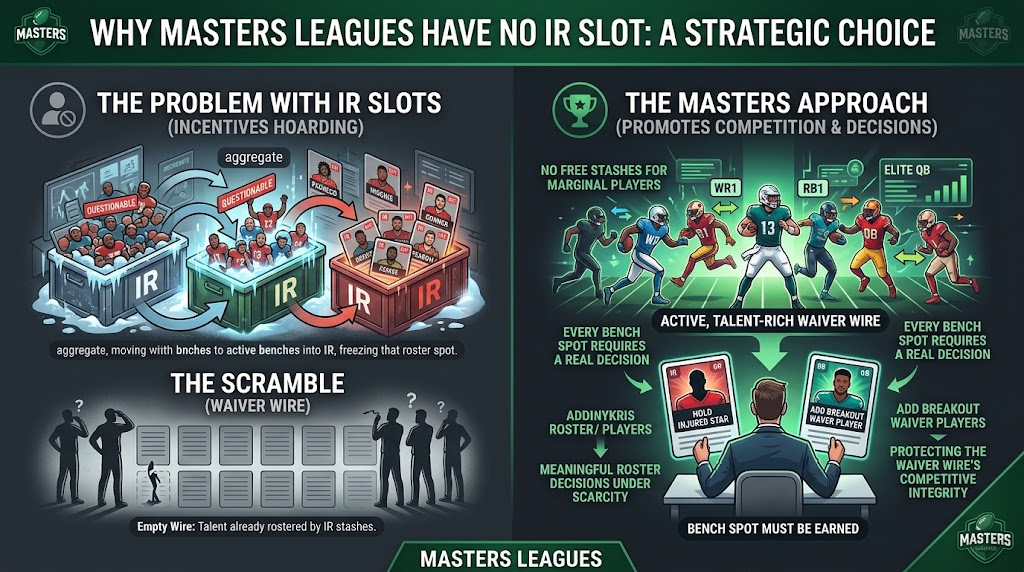
Every year, without fail, someone asks us why Masters Fantasy Football Leagues doesn’t offer an Injured Reserve slot. It’s a fair question — nearly every other platform has one, and on the surface it seems like a no-brainer roster feature. But we’ve thought about this carefully, and we believe leaving IR out of our format is one of the best decisions we’ve made for competitive integrity. Here’s the full reasoning.
What an IR Slot Actually Incentivizes
If we added an IR slot, the incentive is obvious: the second a player picks up a questionable tag — even a marginal, low-upside guy like a Pacheco, a Conner, a Pearsall, or a Higgins-type name — owners would stash him on IR. Why wouldn’t they? It costs nothing. It’s a free roster spot that opens up the moment a bench player gets banged up, regardless of whether that player was ever going anywhere or contributing anything meaningful in the first place.
That sounds harmless in isolation. The problem is what happens in aggregate, and what happens when a real emergency hits.
The Moment It Actually Matters
Every season, there’s a moment where a genuine difference-maker goes down — a true bell-cow running back, a true WR1, a true franchise quarterback. Think Jacobs, Chase, McCaffrey — the names that actually swing a fantasy season. When that happens, owners scramble to the waiver wire looking for a real answer.
Here’s the problem: if we had an IR slot, that waiver wire would already be picked clean. Not because talent doesn’t exist — but because every open roster spot leaguewide has been quietly occupied by a marginal IR stash instead of holding an actual rosterable player. The depth pieces, the handcuffs, the breakout candidates — all of it would be sitting frozen on IR slots across the league, technically “not on a roster” but functionally unavailable, because the owner who has him isn’t using a real roster spot to hold him.
The Counterintuitive Part
Here’s the sharpest version of the argument, and it’s the one that convinces most skeptics: the player you’d want to pick up off waivers right now almost certainly wouldn’t be sitting there if we had an IR slot. He’d already be rostered — sitting on someone else’s bench, in the exact roster spot that got freed up when that owner IR’d a marginal, low-value player earlier in the season.
Without an IR slot, that bench spot has to be earned and defended with an actual decision. An owner has to weigh: is this player worth holding, or do I need this spot for something else? That’s a real roster decision, made under real scarcity — and it’s exactly the kind of decision that should separate good managers from bad ones.
What We’re Actually Protecting
The goal isn’t to punish people for their players getting hurt — injuries are part of the game and nobody’s rosters are immune. The goal is to protect two things we think matter more than convenience: an active, talent-rich waiver wire, and meaningful roster decisions.
We want owners forced to decide whether a bench spot is worth spending on a hurt, low-upside player — instead of getting a mechanism that lets them hoard him for free while that spot effectively disappears from the league’s usable talent pool. We want the wire to be stocked with real difference-makers when injuries hit the players who matter most — not picked over with backups nobody wants because the actual value has been quietly parked on IR slots across dozens of rosters.
No IR isn’t an oversight. It’s a deliberate design choice to keep our leagues sharp, competitive, and true to what fantasy football is supposed to reward: good decision-making under real constraints.
← Back to Masters Fantasy Football Leagues
FAQ
Why doesn’t Masters Fantasy Football Leagues offer an IR slot?
Because it would let owners stash marginal, low-upside players on IR for free the moment they picked up a questionable tag. That freezes those roster spots leaguewide, so when a real starter goes down, the waiver wire is already picked clean instead of stocked with actual talent.
Won’t this hurt owners whose good players get injured?
No IR slot means every bench spot has to be earned and defended with a real decision. That applies to everyone equally, and it’s what keeps the waiver wire competitive for the whole league — including the owner who just lost a starter.
What happens to the players who would normally go on IR?
They stay on rosters or hit waivers like any other player. Owners have to decide whether a banged-up, marginal player is worth an active roster spot — instead of parking him for free and never having to choose.
Does this make the waiver wire more competitive?
Yes. Without an IR slot soaking up marginal players across dozens of rosters, real depth pieces, handcuffs, and breakout candidates stay available on waivers instead of getting frozen out of circulation.