
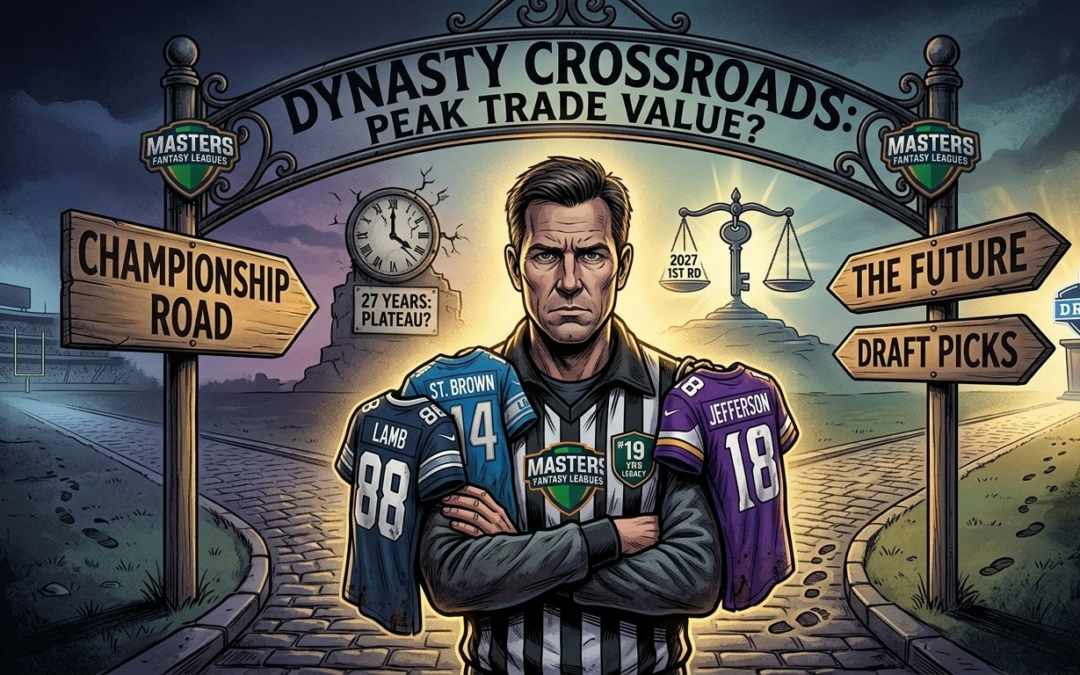
Dynasty Crossroads: When Cornerstones Reach Peak Trade Value
_-By Jonathon Keeton, 17 year commissioner at Masters Fantasy Football Leagues
In dynasty fantasy football, there are certain players that feel almost untouchable.
The kind of players you build entire rosters around. The type you pencil into your lineup every Sunday without even thinking about it.
So even asking this question might feel borderline disrespectful.
But dynasty is a long game. And sometimes the hardest move to make is the one that wins leagues years down the road.
Today we’re talking about three of the most elite wide receivers in fantasy football: CeeDee Lamb, Amon-Ra St. Brown, and Justin Jefferson.
Let me be clear right away: this is not a “they’re finished” article.
Far from it.
These players are still elite and will likely produce at a high level for years.
But dynasty success often comes from asking one uncomfortable question:
Is now the moment when a cornerstone player quietly reaches peak trade value?
CeeDee Lamb – The Target King Facing New Competition
Few receivers in fantasy football have been as dominant recently as CeeDee Lamb. He’s been the centerpiece of the Dallas offense and one of the safest WR1s in the game.
But dynasty managers should at least acknowledge a few shifting variables.
First, Lamb is approaching age 27, which historically begins the phase where wide receiver trade value can plateau or slowly decline in dynasty markets.
Second, Dallas not only added another talented receiver in George Pickens they franchise tagged him, he is a player capable of commanding targets and stretching defenses and beiong a WR1 in his own right. Lamb will still be the focal point, but the days of CeeDee commanding a 30%+ target share are likely behind us.
Again, Lamb is still elite. But if someone in your league views him as the clear-cut WR1 overall, the return could be massive.
And that’s the kind of moment dynasty managers need to at least consider.
Amon-Ra St. Brown – Elite Production, Heavy Mileage
If consistency had a face in fantasy football, it might be Amon-Ra St. Brown.
For four straight seasons he’s been a reception machine, dominating targets and producing elite PPR numbers. Few receivers have been more reliable.
But reliability also means mileage.
St. Brown has piled up an enormous amount of usage over the past several seasons, and he too will be entering the age-27 season, a number dynasty managers historically begin to monitor closely.
Meanwhile, Detroit continues to develop explosive weapons around him, including the rapidly emerging Jameson Williams, whose big-play ability adds another dimension to the offense.
St. Brown isn’t going anywhere. He’s still the engine of the passing attack.
But if another manager still views him as a locked-in top-three dynasty wide receiver, the trade window might quietly be at its peak.
Justin Jefferson – Still the Best, But the Situation Matters
Then there’s Justin Jefferson.
Arguably the most talented wide receiver in football and the type of player dynasty managers dream about building around.
Yet even Jefferson isn’t immune to the variables dynasty managers must evaluate.
Quarterback instability has created some inconsistency in recent seasons, and Jefferson is also approaching that same age-27 milestone that Lamb and St. Brown are entering.
To be clear, Jefferson is still capable of finishing as the overall WR1 in any given season.
But dynasty value isn’t only about talent. It’s about timelines, perception, and market value.
And Jefferson’s market value may never be higher than it is right now.
The Dynasty Age-27 Question
In real football terms, 27 years old is still prime age for wide receivers.
But in dynasty leagues, perception often changes faster than production.
Once a receiver crosses into the late-20s range, managers begin shifting their focus toward younger assets and incoming rookies. That doesn’t mean production disappears — it simply means trade value can slowly decline even while the player remains elite.
Navigating these value peaks is what separates perennial contenders from middle-of-the-pack rosters. If you find yourself holding one of these cornerstones and realize your window to compete has shifted, it might be time to pivot.
Many of the most successful managers we see across our 19 years of operation use these ‘peak value’ moments to trade a single superstar for a haul of assets. You can see this strategy play out in real-time by browsing our live dynasty orphan list, where previous GMs have often already laid the groundwork for a quick turnaround with multiple high-value draft picks.
It’s one of the strange realities of dynasty football:
Sometimes the best time to sell a superstar…
is right before anyone thinks you should.
Final Thought
None of these players are “must sell” candidates.
In fact, holding them and competing for championships is still a perfectly valid strategy.
But dynasty champions are often the managers who recognize when a player’s perceived value and long-term risk briefly intersect.
And there’s one uncomfortable truth dynasty managers rarely like to talk about.
If a major injury were to happen this season, suddenly you’re looking at a player returning at 28 years old, and history shows that the dynasty market can be far less forgiving at that point. Hate to even bring it up — but that kind of timing can dramatically impact a player’s peak trade value.
Which is exactly why moments like this represent a true dynasty crossroads.
At Masters Fantasy Football Leagues, we live and breathe these dynasty crossroads every season. Whether you’re evaluating cornerstones like Lamb, St. Brown, and Jefferson, or hunting the next breakout star, our leagues are built for managers who think long-term and make bold, informed moves.
Dynasty Crossroads is our recurring strategy series examining when elite players reach critical turning points in their dynasty value — and now you can see these lessons applied in action by joining a Masters league.
If you want to see how top dynasty managers approach peak trade value and roster strategy firsthand, join a Masters league and experience the game from the front lines.