At Masters Fantasy Football Leagues, one of our biggest responsibilities as Commish is making sure our leagues stay competitive, engaging, and fun year after year — not just for contenders, but for every manager in the league. One of the most common questions I hear from new players is:
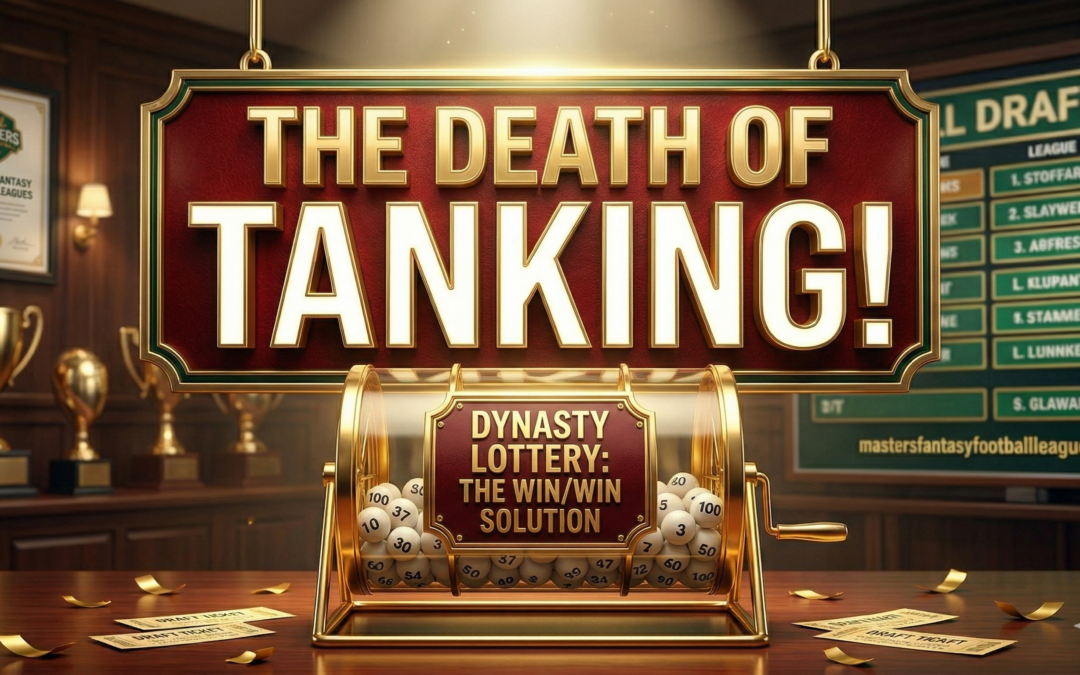
Why use a draft lottery instead of simply giving the top pick to the worst record?
The answer is simple: the draft lottery creates better fantasy football.
Ending the “Race to the Bottom”
In leagues where the worst record automatically earns the 1.01, there’s an obvious temptation to stop competing and start tanking. Late-season matchups lose meaning, lineups get weaker, and the overall product suffers.
A draft lottery changes that dynamic completely.
Even if multiple teams struggle in a given season, no one is guaranteed the top pick. If half the league were racing to the bottom, the odds would be spread out — and it’s entirely possible that a team finishing last wouldn’t end up with as strong a draft position as expected. That uncertainty keeps managers engaged and lineups competitive all the way through the final week.
Every matchup matters.
Where the Lottery Truly Shines: Trading
From a commissioner’s perspective, this is where the draft lottery really separates itself.
In a worst-record system, there’s usually one clear owner of the 1.01. Everyone knows it. Everyone plans around it. The trade market becomes predictable.
With a lottery, that predictability disappears — and that’s a good thing.
Instead of one team controlling the most valuable asset, five or six teams may realistically be in position to land the top pick. That uncertainty turns draft picks into probability-based assets and makes trading far more strategic.
This is the type of strategic depth we strive for at Masters Fantasy Football Leagues.
A League-Wide Experience
The lottery itself becomes an event — something managers talk about, watch together, and react to in real time. Because several teams have a chance at premium picks, the excitement extends across the league, not just the bottom of the standings.
As Commish, that shared engagement is exactly what I want to see.
The Bigger Picture
The draft lottery isn’t about randomness. It’s about balance.
It protects league integrity, discourages tanking, fuels trading, and keeps managers invested year-round. Most importantly, it creates an environment where skill, strategy, and engagement are rewarded.
That philosophy is at the core of how we run leagues at Masters Fantasy Football Leagues — and it’s why so many managers choose to play here season after season.
If you’re looking for leagues that value competition, strategy, and long-term enjoyment, you’ll feel right at home.
Your 2026 Draft Picks Are More Valuable Than You Think
Stop falling for fantasy football Propaganda
By Jonathan Keeton, Commish at Masters Fantasy Football Leagues
Every offseason, it starts the same way.
The “experts.” The rankings. The recycled takes.
“This class only has 5 or 6 elite guys.”
“There’s a clear tier drop.”
“Sell your picks if you’re not in that range.”
And every single year… it’s wrong.
Let’s call it what it is — fantasy football propaganda. The kind that convinces dynasty managers to move valuable future assets at a discount before the market corrects itself.
Because here’s the truth:
Your 2026 rookie picks are far more valuable than you think right now.
The Draft Hasn’t Even Happened Yet
We’re over a month away from the NFL Draft — the single biggest value-shifting event in dynasty football — and people are already acting like the board is set in stone.
It’s not.
Every year, the draft reshapes everything:
Unexpected first-round capital
Surprise landing spots
Depth charts flipping overnight
Players skyrocketing up boards
And yet, managers are trading picks today like we already know how it all plays out.
You’ve heard it:
“There’s a drop after pick 1.05.”
“After the top 6, it’s all the same.”
Sound familiar?
It should — because we hear it every single year.
And every single year, it gets exposed.
There are always players taken after that so-called “drop-off” who become:
Weekly starters
League winners
Cornerstone assets
In fact, I’ll go further:
By Week 3 or 4 of the NFL season, 10+ rookies drafted outside that ‘elite tier’ will gain value — and you’ll wish you had those picks back.
That’s not a hot take.
That’s history repeating itself.
Even the Top Isn’t Locked In
Everyone loves to crown a 1.01 early.
But let me ask you this…
What happens if that changes?
Because it can.
I even think there’s a real possibility that Jermichael Love isn’t the 1.01 in your rookie drafts when it’s all said and done.
All it takes is:
A different player getting elite draft capital and him slipping
A perfect landing spot
Camp buzz + preseason hype
And suddenly, the “sure thing” isn’t so sure anymore.
Picks Are Liquid Gold
Future picks are one of the most flexible assets in dynasty:
They don’t get injured
They don’t underperform
They don’t lose value overnight
If anything, they gain value as uncertainty turns into clarity.
Every step closer to the draft…
Every highlight…
Every depth chart update…
Your picks become more desirable.
So why sell them now — at their lowest informational value?
The Biggest Mistake Dynasty Managers Make
It’s not missing on players.
It’s selling opportunity too early.
Trading away a 2026 1st today for a short-term piece might feel like a win…
But when that pick turns into:
A breakout rookie
Or a trade chip worth significantly more
You’ve locked in a loss before the game even started.
Patience Pays in Dynasty
If you take one thing from this, let it be this:
You don’t have to make the move today.
At minimum:
Wait for the NFL Draft
Let the hype build
Let the market come to you
Because it always does.
And when it does, your picks won’t be “just picks” anymore…
They’ll be targets everyone wants.
Final Thought
We say it every year, and it never changes:
The best dynasty players don’t chase value — they wait for it to come to them.
So before you move your 2026 picks for pennies on the dollar…
Take a breath.
Let the draft happen.
Let the chaos unfold.
Let the value rise.
Because chances are…
You’re holding gold — you just don’t realize it yet.
At Masters Fantasy Football Leagues, we’ve been providing a professional home for serious GMs since 2008. Come join a league where strategy matters and your prize pool is always secure.
The Dynasty Verdict: The Case for Selling Drake Maye Right Now
Breaking down the biggest dynasty decisions facing fantasy managers.
Court is now in session.
Today’s case before the dynasty court: What should managers do with one of the most exciting young quarterbacks in fantasy football?
In dynasty fantasy football, finding a franchise quarterback is the ultimate prize—especially in Superflex formats. When you land one, the instinct is simple: lock him in and build around him for the next decade.
Right now, few young quarterbacks have captured the imagination of dynasty managers quite like Drake Maye. His size, arm talent, and flashes of brilliance have quickly made him one of the hottest assets in the dynasty market.
In many leagues, Maye is already valued among the elite young quarterbacks.
But dynasty football is all about timing.
And sometimes the hardest question a manager has to ask is this:
Should you hold your cornerstone… or submit a blockbuster trade offer into evidence?
The Rookie Darling Cycle
Every year the dynasty community crowns a new quarterback as the next long-term superstar. Their value skyrockets, trade offers flood in, and suddenly they become “untouchable.”
But as someone who has watched plenty of dynasty seasons unfold, I’ve seen managers make bold moves involving quarterbacks like C.J. Stroud and Jayden Daniels when their market value reached its absolute peak.
At the time, those deals looked shocking.
But in many cases, the managers who sold high walked away with a mountain of draft capital and a much stronger roster long term.
Which brings us back to today’s case.
Drake Maye.
Looking at the Situation
Maye’s talent is undeniable, but dynasty managers should always evaluate the full picture.
Last season, Maye benefited from a relatively favorable schedule. Against teams that finished above .500, he threw just two touchdowns, showing that stronger defenses sometimes slowed the offense down.
There are also questions about the supporting cast. With the departure of veteran receiver Stefon Diggs, the offense still lacks a deep group of proven playmakers.
For a young quarterback still developing, surrounding talent can make the difference between solid fantasy production and elite numbers.
The Superflex Value Explosion
Here’s the key point.
Quarterbacks with Maye’s profile in Superflex leagues can command enormous trade returns.
In dynasty court terms, the offers start looking like compelling evidence.
It’s not unrealistic to see packages in the range of:
Three first-round picks
Plus additional assets or young players
That kind of return can fundamentally change a roster.
The Rebuild Accelerator
Here’s a strategy I’ve seen many experienced dynasty managers use.
They trade a highly valued young quarterback for a massive haul and temporarily plug in a journeyman veteran quarterback for a season or two.
While that veteran may not have the same long-term upside, he can provide steady production while the roster improves elsewhere.
Meanwhile, the extra picks and assets from the trade allow you to:
Add multiple young starters
Build depth across the roster
Stockpile future draft capital
Suddenly, a rebuild that might have taken four years can accelerate dramatically.
In dynasty, turning one elite asset into several strong pieces can sometimes be the fastest path back to contention.
To be clear—this isn’t an argument that Drake Maye will fail. He may absolutely become a long-term fantasy star.
But dynasty success often comes from recognizing when the market is at its highest.
If another manager values Maye as a guaranteed elite quarterback and is willing to send a king’s ransom, the real question isn’t whether he’s talented.
The question is this:
Has Drake Maye already reached peak trade value?
Because at the dynasty crossroads, sometimes the smartest move is the one that feels the hardest to make.
_-By Jonathon Keeton, 17 year commissioner at Masters Fantasy Football Leagues
In dynasty fantasy football, there are certain players that feel almost untouchable.
The kind of players you build entire rosters around. The type you pencil into your lineup every Sunday without even thinking about it.
So even asking this question might feel borderline disrespectful.
But dynasty is a long game. And sometimes the hardest move to make is the one that wins leagues years down the road.
Today we’re talking about three of the most elite wide receivers in fantasy football: CeeDee Lamb, Amon-Ra St. Brown, and Justin Jefferson.
Let me be clear right away: this is not a “they’re finished” article.
Far from it.
These players are still elite and will likely produce at a high level for years.
But dynasty success often comes from asking one uncomfortable question:
Is now the moment when a cornerstone player quietly reaches peak trade value?
CeeDee Lamb – The Target King Facing New Competition
Few receivers in fantasy football have been as dominant recently as CeeDee Lamb. He’s been the centerpiece of the Dallas offense and one of the safest WR1s in the game.
But dynasty managers should at least acknowledge a few shifting variables.
First, Lamb is approaching age 27, which historically begins the phase where wide receiver trade value can plateau or slowly decline in dynasty markets.
Second, Dallas not only added another talented receiver in George Pickens they franchise tagged him, he is a player capable of commanding targets and stretching defenses and beiong a WR1 in his own right. Lamb will still be the focal point, but the days of CeeDee commanding a 30%+ target share are likely behind us.
Again, Lamb is still elite. But if someone in your league views him as the clear-cut WR1 overall, the return could be massive.
And that’s the kind of moment dynasty managers need to at least consider.
Amon-Ra St. Brown – Elite Production, Heavy Mileage
If consistency had a face in fantasy football, it might be Amon-Ra St. Brown.
For four straight seasons he’s been a reception machine, dominating targets and producing elite PPR numbers. Few receivers have been more reliable.
But reliability also means mileage.
St. Brown has piled up an enormous amount of usage over the past several seasons, and he too will be entering the age-27 season, a number dynasty managers historically begin to monitor closely.
Meanwhile, Detroit continues to develop explosive weapons around him, including the rapidly emerging Jameson Williams, whose big-play ability adds another dimension to the offense.
St. Brown isn’t going anywhere. He’s still the engine of the passing attack.
But if another manager still views him as a locked-in top-three dynasty wide receiver, the trade window might quietly be at its peak.
Justin Jefferson – Still the Best, But the Situation Matters
Then there’s Justin Jefferson.
Arguably the most talented wide receiver in football and the type of player dynasty managers dream about building around.
Yet even Jefferson isn’t immune to the variables dynasty managers must evaluate.
Quarterback instability has created some inconsistency in recent seasons, and Jefferson is also approaching that same age-27 milestone that Lamb and St. Brown are entering.
To be clear, Jefferson is still capable of finishing as the overall WR1 in any given season.
But dynasty value isn’t only about talent. It’s about timelines, perception, and market value.
And Jefferson’s market value may never be higher than it is right now.
The Dynasty Age-27 Question
In real football terms, 27 years old is still prime age for wide receivers.
But in dynasty leagues, perception often changes faster than production.
Once a receiver crosses into the late-20s range, managers begin shifting their focus toward younger assets and incoming rookies. That doesn’t mean production disappears — it simply means trade value can slowly decline even while the player remains elite.
Navigating these value peaks is what separates perennial contenders from middle-of-the-pack rosters. If you find yourself holding one of these cornerstones and realize your window to compete has shifted, it might be time to pivot.
Many of the most successful managers we see across our 19 years of operation use these ‘peak value’ moments to trade a single superstar for a haul of assets. You can see this strategy play out in real-time by browsing our live dynasty orphan list, where previous GMs have often already laid the groundwork for a quick turnaround with multiple high-value draft picks.
It’s one of the strange realities of dynasty football:
Sometimes the best time to sell a superstar…
is right before anyone thinks you should.
Final Thought
None of these players are “must sell” candidates.
In fact, holding them and competing for championships is still a perfectly valid strategy.
But dynasty champions are often the managers who recognize when a player’s perceived value and long-term risk briefly intersect.
And there’s one uncomfortable truth dynasty managers rarely like to talk about.
If a major injury were to happen this season, suddenly you’re looking at a player returning at 28 years old, and history shows that the dynasty market can be far less forgiving at that point. Hate to even bring it up — but that kind of timing can dramatically impact a player’s peak trade value.
Which is exactly why moments like this represent a true dynasty crossroads.
At Masters Fantasy Football Leagues, we live and breathe these dynasty crossroads every season. Whether you’re evaluating cornerstones like Lamb, St. Brown, and Jefferson, or hunting the next breakout star, our leagues are built for managers who think long-term and make bold, informed moves.
Dynasty Crossroads is our recurring strategy series examining when elite players reach critical turning points in their dynasty value — and now you can see these lessons applied in action by joining a Masters league.