
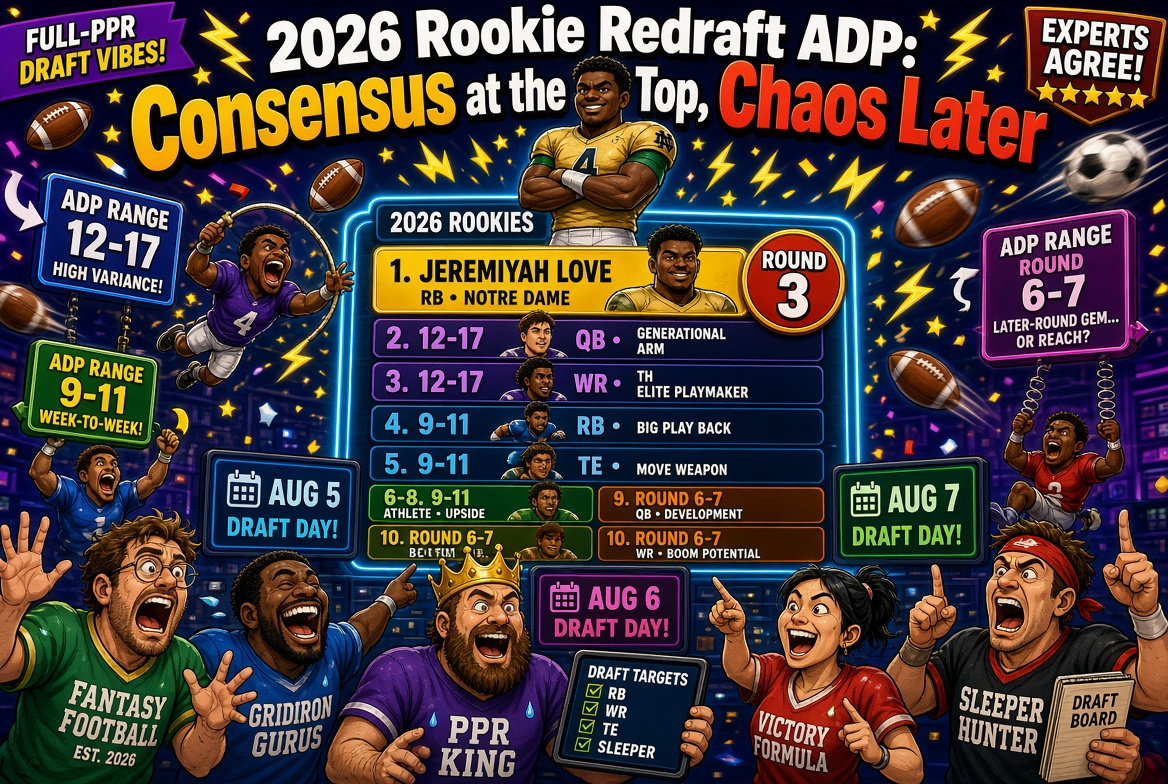
If you want to know where the 2026 rookie class is actually being drafted in redraft fantasy football leagues, rankings only get you so far. Real drafts tell a different story.
We compared three actual 2026 full-PPR redraft drafts held on August 5, August 6, and August 7. We looked exclusively at the 2026 rookies from our selected pool — no 2025 rookies, no veterans, no dynasty rankings. Just the 2026 class and the exact spots where fantasy managers selected them.
The results are revealing. Some rookies have settled into extremely tight draft ranges. Others are swinging by multiple rounds from one draft to the next. Three drafts is a limited sample, but the patterns that emerge are still worth paying attention to. The clearest takeaway: 2026 rookie ADP is not nearly as locked in as many assume.
Want to draft these rookies yourself instead of just reading about where they go? We run live full-PPR redraft drafts throughout the season — jump into an upcoming draft, test these ADP ranges in real time, and see how the market shifts as more data comes in. Spots are limited and fill quickly as the season approaches.
2026 Rookie Redraft ADP Comparison
Here are the 2026 rookies from our selected player pool who were drafted in at least one of the three leagues:
| 2026 Rookie | Aug. 5 | Aug. 6 | Aug. 7 | Avg ADP | Range |
|---|---|---|---|---|---|
| Jeremiyah Love | 3.09 | 3.07 | 3.12 | 3.09 | 5 picks |
| Carnell Tate | 6.11 | 6.06 | 7.02 | 6.10 | 8 picks |
| Jadarian Price | 6.06 | 6.07 | 6.11 | 6.08 | 5 picks |
| Jordyn Tyson | 8.09 | 7.11 | 9.06 | 8.09 | 19 picks |
| Makai Lemon | 9.04 | 11.07 | 9.12 | 10.04 | 27 picks |
| KC Concepcion | 12.07 | 12.07 | 14.11 | 13.05 | 28 picks |
| Kenyon Sadiq | 13.12 | 13.07 | 14.01 | 13.10 | 6 picks |
| De’Zhaun Stribling | 12.06 | 13.06 | 14.09 | 13.07 | 27 picks |
| Jonah Coleman | 16.06 | 16.01 | 15.11 | 16.02 | 7 picks |
| Antonio Williams | 16.07 | 15.03 | 18.04 | 16.08 | 37 picks |
| Kaelon Black | 16.05 | 17.03 | 12.06 | 15.05 | 57 picks |
| Mike Washington Jr. | 18.06 | 15.11 | — | — | — |
| Zachariah Branch | 18.12 | 16.02 | — | — | — |
| Omar Cooper Jr. | — | 17.08 | — | — | — |
| Ja’Kobi Lane | — | 18.03 | — | — | — |
The remaining players from the selected rookie pool — including Fernando Mendoza, Nicholas Singleton, Eli Stowers, Emmett Johnson, Germie Bernard, Kaytron Allen, Malachi Fields, Ted Hurst, Demond Claiborne, Elijah Sarratt, Chris Bell, Skyler Bell, Ty Simpson, and Adam Randall — went undrafted in all three leagues. That absence is useful information in its own right.
Jeremiyah Love Is the Clear 2026 Rookie Consensus
Jeremiyah Love is the standout. He was drafted 3.09 on August 5, 3.07 on August 6, and 3.12 on August 7 — an entire range spanning just five picks. That level of consistency across three different groups of managers is rare.
In the August 5 draft, Love came off the board at 3.09, just ahead of Cam Skattebo at 3.12. The next night he went 3.07. On August 7 he landed at 3.12. Three drafts, three sets of managers, nearly identical results. Love is the most reliable 2026 rookie redraft ADP in this sample, and there’s little debate about him belonging in the third round. That consensus tracks with what we saw live at the draft table too — our recap of a historic second-round run in a recent Bronze division live draft has Love coming off the board even earlier, at pick 2.10. The more interesting question is whether Love’s ADP keeps climbing into Round 2 as the season nears.
Carnell Tate Has a Clear Sixth-to-Seventh-Round Range
Carnell Tate is another player with a defined landing spot: 6.11, 6.06, and 7.02 — an eight-pick spread. Tate is living around the Round 6/7 turn. You don’t need to reach several rounds early, but you also can’t assume he’ll still be available deep into the middle rounds.
Jadarian Price Might Be the Most Predictable Middle-Round Rookie
Jadarian Price is the definition of consistency. His three picks — 6.06, 6.07, and 6.11 — are separated by only five spots. On August 6 he went immediately after Tate. The market appears settled on a specific range for Price, and for managers hunting middle-round 2026 rookies, that stability is valuable.
Jordyn Tyson Is One of the Biggest Rookie Wild Cards
Jordyn Tyson is where the variance starts to show. He went 8.09, 7.11, and 9.06 — a 19-pick difference, nearly two full rounds. If you love Tyson, you need to know how aggressive the other managers in your league are likely to be. Waiting until Round 9 works in some rooms and gets you burned in others.
Makai Lemon Has an Even Bigger Range
Makai Lemon’s results underline the uncertainty still present in the class. His selections — 9.04, 11.07, and 9.12 — span a 27-pick range. Two drafts put him around Round 9; one pushed him nearly two rounds later. Round 9 currently looks like the market’s preferred range, while Round 11 represents a clear discount when managers don’t share the same evaluation.
KC Concepcion Shows a Major Late-Round Difference
KC Concepcion went 12.07, 12.07, and 14.11. The first two drafts produced the exact same pick — strong evidence of a Round 12 consensus. The third draft pushed him nearly two rounds later. That combination of consensus and opportunity makes him an interesting late-round target.
Kenyon Sadiq Is More Stable Than His Round Suggests
Kenyon Sadiq’s range — 13.12, 13.07, and 14.01 — is only six picks. All three selections landed in the Round 13/14 area. Late-round tightness can be just as useful as early-round consensus when you’re planning your draft board.
De’Zhaun Stribling Is Another Rookie With a Wide Range
Stribling moved 12.06, 13.06, and 14.09 — a 27-pick spread, with the movement trending later across the three drafts. Small sample, but worth monitoring as more results come in.
Jonah Coleman Is Extremely Consistent
Jonah Coleman may be the most overlooked consistency story in the group. His picks — 16.06, 16.01, and 15.11 — span only seven spots, all landing right at the Round 16/17 boundary. For late-round 2026 rookies, that kind of reliability is useful.
Antonio Williams Has a Huge ADP Swing
Antonio Williams went 16.07, 15.03, and 18.04 — a 37-pick difference, more than three full rounds. He is one of the clearest wild cards in the sample and can create very different draft opportunities depending on the room.
Kaelon Black Is the Biggest ADP Wild Card of All
Kaelon Black produced the most dramatic swing in the sample: 16.05, 17.03, and 12.06 — a 57-pick difference, nearly five rounds, between his earliest and latest selection. One manager saw a Round 12 player; another saw a Round 17 player. That gap is the purest illustration of how individual drafts can diverge.
Mike Washington Jr. and Zachariah Branch Also Show Major Disagreement
Mike Washington Jr. appeared in two drafts (18.06 and 15.11) and went undrafted in the third. Zachariah Branch was taken at 18.12 and 16.02 and also went undrafted once. Both remain firmly in the late-round flyer category with no reliable ADP yet.
Omar Cooper Jr. (17.08) and Ja’Kobi Lane (18.03) were each selected only once. That’s not enough for a true ADP, but it does show they’re entering the conversation in the deepest rounds rather than being completely ignored.
The Biggest 2026 Rookie ADP Differences
- Kaelon Black — 57 picks (12.06 to 17.03)
- Antonio Williams — 37 picks (15.03 to 18.04)
- KC Concepcion — 28 picks (12.07 to 14.11)
- De’Zhaun Stribling — 27 picks (12.06 to 14.09)
- Makai Lemon — 27 picks (9.04 to 11.07)
- Jordyn Tyson — 19 picks (7.11 to 9.06)
These are not minor fluctuations. Multiple-round gaps create real strategic opportunities.
The Most Consistent 2026 Rookie ADPs
- Jeremiyah Love — 3.07 to 3.12 (5 picks)
- Jadarian Price — 6.06 to 6.11 (5 picks)
- Kenyon Sadiq — 13.07 to 14.01 (6 picks)
- Jonah Coleman — 15.11 to 16.06 (7 picks)
- Carnell Tate — 6.06 to 7.02 (8 picks)
These are the players where the three drafts showed the strongest agreement.
The Biggest Takeaway: Consensus Ends Earlier Than You Think
There’s a relatively clear hierarchy at the top of the 2026 rookie class in redraft. Jeremiyah Love is firmly in Round 3. Carnell Tate and Jadarian Price sit around Round 6. After that, the ranges widen quickly — Tyson moves between Rounds 7-9, Lemon between 9-11, Concepcion between 12-14, Williams between 15-18, and Black anywhere from Round 12 all the way to Round 17.
The farther you get from the top of the class, the less consensus exists. That’s exactly what useful redraft data should reveal.
What This Means for 2026 Full-PPR Redraft Strategy
Redraft ADP is fundamentally different from dynasty rookie rankings. In dynasty, managers can justify early picks based on long-term upside. In redraft, the question is simpler: how much can this rookie help me in 2026? That shifts the entire calculus. A player doesn’t need to become a future superstar — he needs to produce usable production this season. Real draft results show what managers are actually willing to pay right now.
If you’re still working through your broader draft board before rookies even enter the picture, our recent piece on why waiting on quarterback is one of the smartest fantasy football draft strategies in 1QB leagues is a useful companion read, since it directly affects how many mid-round picks you’ll have available to spend on rookies like these.
Where the Potential 2026 Rookie Values Are
The biggest opportunities live with the high-variance players. Makai Lemon can go as early as Round 9 or as late as Round 11. KC Concepcion can sit in Round 12 or fall to Round 14. Kaelon Black can be a Round 12 pick or a Round 17 dart throw. The goal isn’t to declare one draft “correct” — it’s to understand the range so you can identify when a player becomes a value in your specific room. That same discipline applies beyond rookies, too — our breakdown of redraft sleepers versus traps for 2026 covers how to separate a genuine value from a name that’s just overhyped.
Why These Three Real Drafts Matter
Rankings are useful. Real draft results answer a more practical question: when are people actually willing to take these players? These were not mocks or projections — they were actual 2026 full-PPR redraft selections. The differences highlight where the market has settled and where it’s still searching for answers. For more on what real 2026 drafts have been showing so far, see our breakdown of what the latest Masters Fantasy Football redraft reveals about winning draft strategy in 2026.
Final Verdict: Consensus at the Top, Chaos Later
Jeremiyah Love is the most stable high-end 2026 rookie in this sample — three straight drafts between 3.07 and 3.12. Carnell Tate and Jadarian Price also show impressive consistency around Round 6. After that, uncertainty grows. Jordyn Tyson, Makai Lemon, and KC Concepcion carry wider ranges. The later rounds become even more unpredictable, with Antonio Williams swinging three rounds and Kaelon Black swinging five.
For managers preparing for 2026 full-PPR redraft leagues, the lesson is clear: knowing who the rookies are is only half the battle. Knowing when the other managers in your league are willing to take them is where the advantage lives. If three real drafts can produce multi-round differences, the manager who understands those ranges can turn draft position into real value.
Ready to test these ranges yourself? Check out our complete live draft schedule, or see today’s available drafts at the top of our home page.
Frequently Asked Questions
Who is the most consistently drafted 2026 rookie? Jeremiyah Love (3.09, 3.07, 3.12).
What round is Carnell Tate being drafted in? Between the sixth and seventh rounds (6.11, 6.06, 7.02).
What round is Jadarian Price being drafted in? Extremely consistent in the sixth round (6.06, 6.07, 6.11).
Which 2026 rookie has the biggest ADP difference? Kaelon Black (12.06 to 17.03).
Which 2026 rookies have the most uncertain redraft ADP? Kaelon Black, Antonio Williams, Makai Lemon, De’Zhaun Stribling, and KC Concepcion.
Are these dynasty rookie rankings? No. These results come exclusively from 2026 full-PPR redraft leagues.
Are 2025 rookies included? No. This comparison focuses only on the 2026 class.
Why are some 2026 rookies missing from the table? Only players drafted in at least one of the three leagues appear. Several from the selected pool went completely undrafted, which is itself useful information for late-round evaluation.
What is the best way to use this 2026 rookie ADP information? Treat it as a range rather than a rigid ranking. The gap between a player’s earliest and latest selection often reveals the biggest opportunities.