
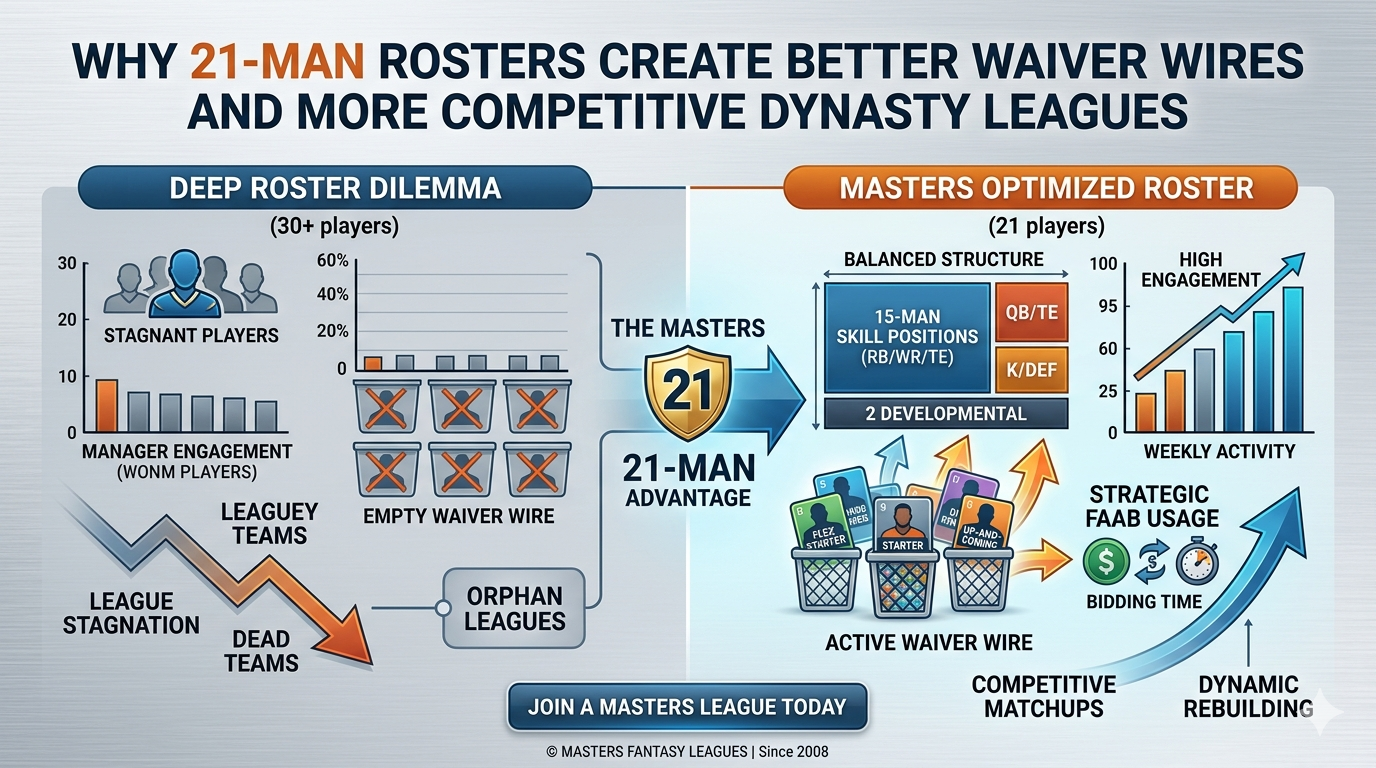
If you’ve played dynasty fantasy football long enough, you’ve seen the “Dead League” syndrome: massive 30+ man rosters, completely empty waiver wires, and half the managers checked out by midseason because they have no path to improve.
At Masters Fantasy Leagues, we made an intentional decision to build our dynasty format around a 21-man roster size. We realize injuries happen and managing through them is part of the game, but the smaller roster size is specifically designed to force tougher, more meaningful decisions.
1. The Math of a “Deep” 21-Man Roster
On the surface, 21 might sound tight, but the composition is carefully balanced for competition. A standard Masters roster is designed for:
-
1 Kicker and 1 Defense
-
2 QBs and 2 TEs
-
5 WRs and 5 RBs
-
3 Flex positions (WR/RB/TE/QB)
-
2 Developmental spots
We start six WR/RB/TE players, so having a 15-man core for those positions is actually quite deep. It provides enough room for a solid bench while still ensuring the waiver wire remains a strategic asset. You can see the full breakdown of how these rosters function on our Dynasty Rules Page.
2. Blind Bidding (FAAB) Actually Matters
In many dynasty leagues, FAAB strategy is an afterthought because every player with a pulse is already stashed on a deep bench. In a 21-man format, the player pool is tighter, which changes the game:
-
Hard Choices: Tighter pools mean you have to make real decisions on who to keep and who to cut.
-
Strategic Investment: Valuable players actually hit the wire, meaning your FAAB dollars are a legitimate weapon to improve your roster.
-
Competitive Edge: Timing your bids becomes a skill that separates the sharp managers from the pack.
3. A Waiver Wire That Stays Alive All Season
Think about the impact of expanding rosters by just two spots. If every team in a 12-team league added two IR or roster spots, that would take the top 24 players off the waiver wire. Most managers rarely find a viable target once they are looking at the 25th-best available player. By keeping rosters at 21, the wire stays active with flex-worthy contributors and emerging young players.
4. Preventing the “Orphan” Cycle
One of the biggest hidden dangers of deep rosters is that they make rebuilding almost impossible. When the waiver wire is barren, a struggling team has no way to inject new talent quickly. This leads to stagnant rosters, frustrated managers, and harder-to-fix teams.
Our 21-man format ensures that every team has a path to retool quickly, keeping managers engaged and leagues stable. If you’re ready to test your skills by turning a roster around, check out our current list of available Orphans.
The Bottom Line
Choosing a 21-man roster doesn’t make winning easier—it raises the bar for management. It rewards the active, the strategic, and the forward-thinking. Once you experience a dynasty league where every roster move actually matters, you won’t want to go back to a “dead” wire again.
How This Ties Into The Masters Advantage
The 21-man roster format doesn’t exist in a vacuum — it’s one of the core pieces of what we call The Masters Advantage.
On its own, roster size changes how managers make decisions. But when you combine it with a 3-round rookie draft, an active waiver wire, and constant roster pressure across the league, it becomes something much bigger: a system designed to keep dynasty fantasy football active year-round.
We break this full structure down in our main pillar article, where we explain how all of these settings work together to create nonstop engagement, constant player movement, and a waiver wire that actually matters.
Explore the bigger picture here:
The Masters Advantage: Why Our Dynasty Format Stays Active Year-Round
Visit the Masters Fantasy Football Homepage to find your next league.